Baikal 2014
Translated from Russian Read the original →
Travel & MountainsRelationships, Love & FamilyBody, Breath & Movement
A Journey to Baikal
“…Giving oneself up to the deception of life-endangering deeds, reaching the limit of this life, walking carelessly, driven by the red energy of one’s own karma, led towards the Lord of Death. When you depart for the next world alone, all your riches, your loved ones and those close to you will not follow you. So all the previous Buddhas taught…”
(these are the words that open the film “The Phenomenon of Khambo Lama Itigelov”, a film imbued with the spirit of these places and revealing the essence of the Buddhist tradition).
Chapter 1. Travelling companions and the threshold of the meeting.
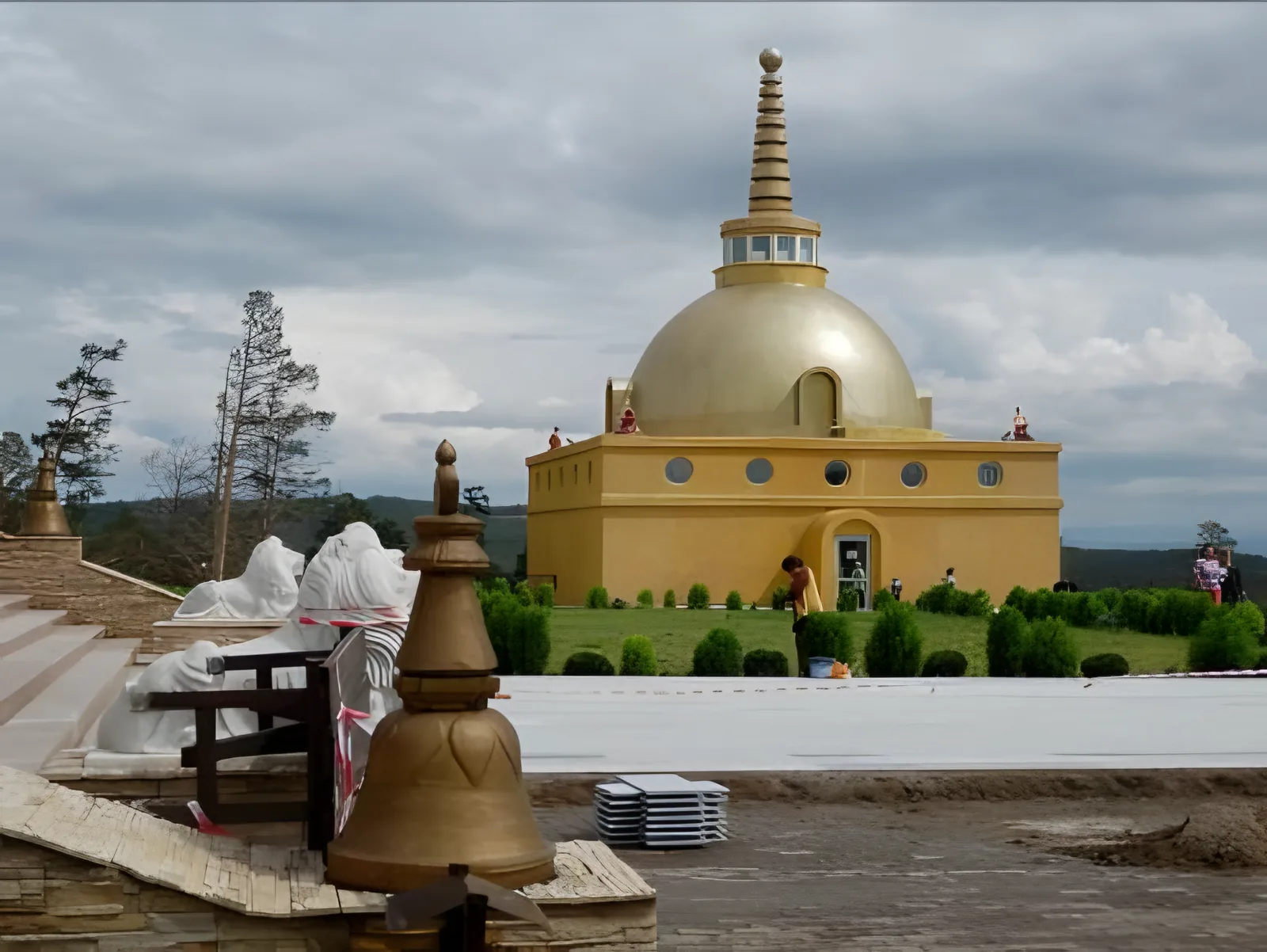
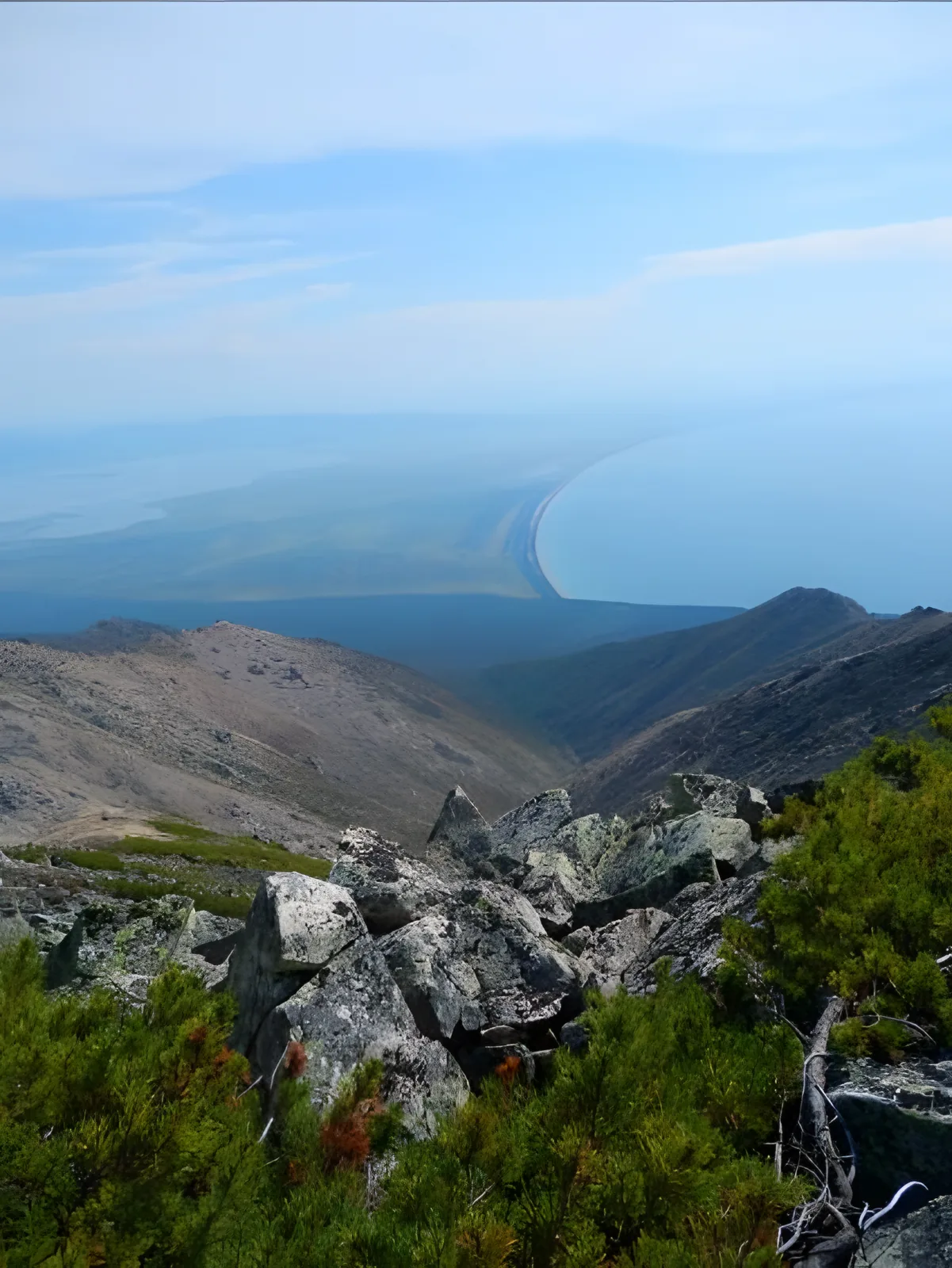
Walking over the land of Buddhist temples, rowing from bay to bay, bathing in the sacred waters of the Great Freshwater Sea, climbing to the mountain plateau of the Svyatoy Nos peninsula (1,800 m), in order to stop in wonder at the sight of a jewel set in the taiga shores – Baikal from above.
To see it and freeze, feeling yourself a human being born on earth as if for the first time, and to behold a world as though this world had appeared a second ago….
And so, tuned in to the place, to visit the incorruptible Khambo Lama Itigelov, whom people worshipped as a god even in his lifetime, and who in 1927, at a gathering for prayer, announced to his brethren that he had sat down into his last meditation and is in it still.
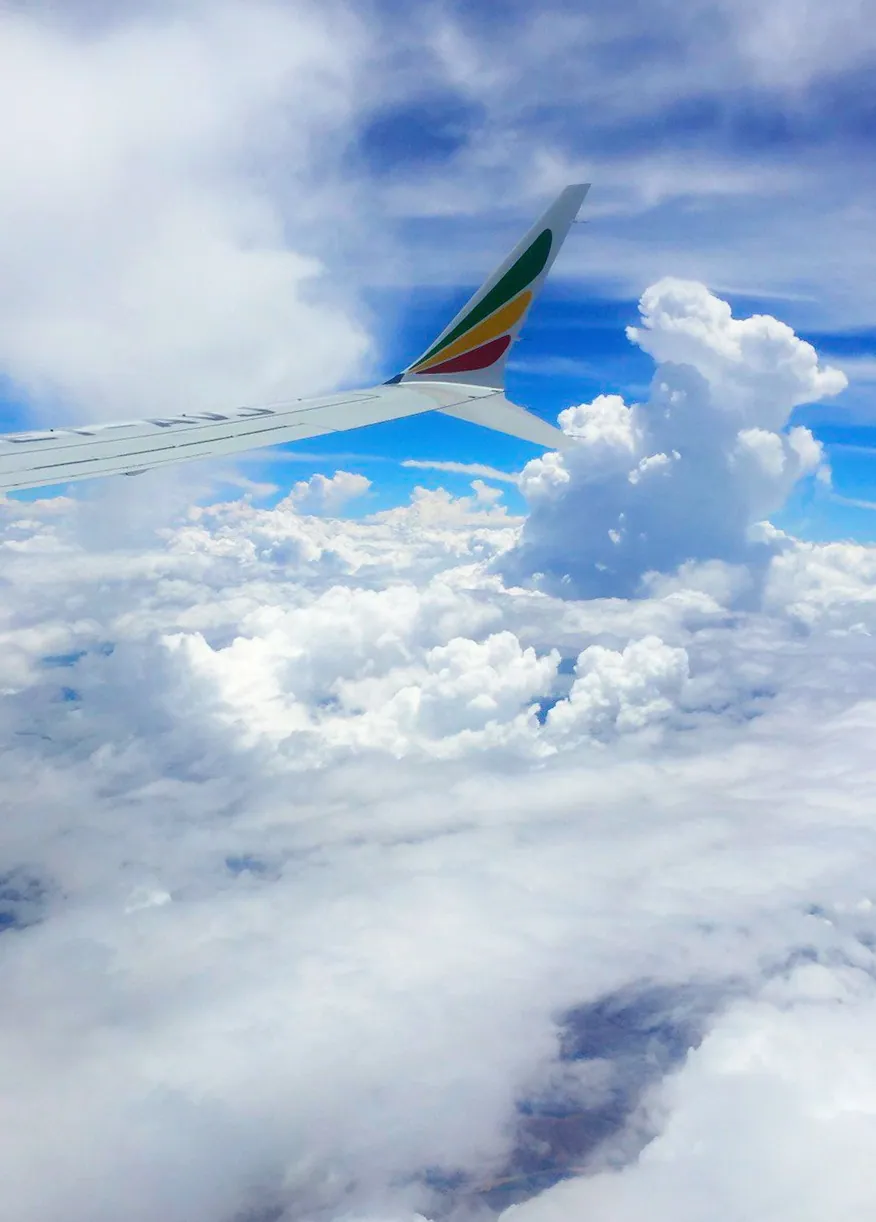
We landed in Ulan-Ude, where round-faced Buryat girls in Aeroflot uniforms met the passengers with broad smiles and dimples in their cheeks. Fresh taiga air was carried on the winds even to the steppe outskirts of Ulan-Ude, the capital of Buryatia, and it no longer let my thoughts drift from the place I had flown to, in order to lead a group of travellers whom this purest, vast zero had called – to lead the members of the expedition through their inner realities. For the outer route a local guide was waiting for us, Vladlen Vydrin.
The meeting place for the participants had been set at the Rinpoche Bagsha datsan on Lysaya Gora (Bald Mountain). A retired Russian officer took me there from the airport. Stepping out of his car with a folder, he saw me watching the last taxi of this little airport drive away, and offered that if I could wait another 10 minutes, he would drop off his documents and take me wherever I needed – namely, to a Buddhist monastery. I breathed in the smells and studied the airport staff.
On the way to the datsan I learned that this man had served on submarines in Soviet times. He had happened to take part in a dive lasting a whole year. In such a psychological “experiment” on people (and where can you go from a submarine?), an observant person is given flashes of insight by taking part in, and watching, the other members of a small crew. In the conditions of a closed, limited space, artificially created by living on an underwater vessel, such a crew produces an unprecedented psychological stretch – it gives people contact with their own limits and exposes the individual features of the psyche and its deep complexes. Of course, there it happens not for the sake of the experiment itself but for other, military aims, although who knows, who knows… After all, ascetic practices of various kinds – fasting, Vipassana practice, deprivation chambers, blind Retreats and other specially created long situations that limit us in something – have long been used by humans to know and develop their nature. These processes are the basis of all advanced psychotechniques and spiritual practices.
Although classical psychotherapy avoids them in a panic, because it works with obvious, already manifested client traumas and situational breaches in their lives. But for whole people, not “wounded” ones, not those who need rehabilitation but those who are psychologically stable enough and active, yet want to develop and go beyond their limits, ascetic practices are a PATH that truly forms abilities and “polishes the diamond”.
Even an asceticism of giving up the internet and the telephone is very useful for a modern person. Our journey implied exactly this format.
So military people, deprived of the warmth of relationships with their loved ones, in a closed space, in a situation of strict military hierarchy, without suspecting it find themselves in conditions that (if accepted fully) would greatly further their development. “What doesn’t kill us makes us stronger.”
After watching the video from “field conditions” on his phone, I said to the officer: “A colleague of mine who went through a very harsh army in Soviet times once said that the army is the best training. Because such resources are brought in there to create conditions for development that we trainers in psychology can never create on that scale. After all, if you look at it all precisely as a training, with immersion in awareness of your inner reactions, then it is quite likely you can reach complete enlightenment. Sometimes there is no other way to survive there…”
It was interesting to learn directly from a submariner what metamorphoses happen to the psyche of people in a closed collective. That psychology turns out to be a very useful science for those who spend many months in a closed space – it was pleasant and unexpected to hear this from a mature military man with a remarkably strong and deep voice. As a psychologist, I took in every word the military man said about “people from the depths”. I think I won him over to such a frank story about his life by introducing myself as a Kyivan and, after hearing out everything a Russian officer may think about the Maidan and those in power in Ukraine, keeping neutral.
He softened and, as if apologising, added: “Yes, perhaps it is all a difference of mentality; in our army there was a saying – ‘A Zaporozhets is not a car, a Kyivan is not a man’. But don’t think I mean that literally. I mean that ‘yours’ don’t like to submit… to force… and somehow strangely don’t strive to lead, so the wheel ends up going to every ambitious rabble.”
The road was long, and then his I-stories followed, which for me are incomparably livelier and more valuable in a person than assessments of events that didn’t happen to him. The officer categorically refused to take money for the ride, and did it so calmly, without pathos, as real men do – satisfied with their male gender might. “Might” here comes from “those who can afford it”. And gestures like this come from the fullness of one’s abundance, or simply from an abundance of curiosity about giving a lift to a woman with a big rucksack on her back and chatting idly.
And the air again! Air carrying the smells of water from afar on an east wind.
Less than a day will pass before I find out what it is like: to swim and drink water at the same time, water impossibly clean and tangibly transparent. I will swim towards the sunset along the shining path of the setting sun, which will sink “upside down” into long horizontal clouds, near the sky and the water, surfacing from the dark cloud below and throwing up distinct rays – “the eyelashes of God”. And it will seem to me that very, very long ago this place was waiting for me. For me and for the participants of the journey who ended up here today. And once more, in this mystical mood, I will be sure of the feeling that the places, events and people through whom my path runs are not at all accidental.
Passing through the bright gates of the monastery and going round the main building, I saw a gazebo and people with big rucksacks in it.
The general gathering and introductions of the members of our group took place on the monastery grounds; here we would wait for the guide and tune in to the journey. The monastery stands on a big hill, and the view from here opens onto great distances in all four directions. We were in a gazebo whose perimeter was made of prayer drums. From this viewing platform we could see the city, the fields and the forests, threaded by arteries of rivers rushing towards Baikal.
Along a paved path a tall and slim (in every sense) girl came towards me, throwing open her arms – Anechka Dobrovolskaya! We had not seen each other for many months. She is from Kramatorsk, formerly a student and now a friend and the main initiator of this journey. All the participants were already there: a couple from Yekaterinburg – a grey-haired, cultured man and his lady, a sporty, sturdy brunette – a gorgeous blonde from Kyiv, and our guide. Now we got acquainted again in the flesh, no longer over the internet, and were surprised at how our ideas of each other’s “bright image” matched and didn’t match. We shared expectations about what each might have as the goal of the journey, and our official versions of why it was useful for us to come here, understanding that “it will be what it will be”, and the main thing in this last saying is the verb. This being my eleventh expedition, I know that by the end of the journey a person changes so much that the goal she set for herself at the start, by the end of the expedition, is touching – touching because the outcome turns out to be one that becomes clear to a person, though at the start she could not even imagine it, let alone set it as a goal! When you manage to live your path LIKE THAT, going beyond the plan, accepting unforeseen turns and new results, then real Life happens to a person, making her new. And in the new self we find unheard-of resources.
A Buryat wedding will march past us – like a cloud on blue – a snow-white bride and her 8 bridesmaids all in the same turquoise. Airy girls, like fairy-tale fairies, swept around us, setting the prayer drums spinning. With this gesture they closed the perimeter of our gazebo, in which our getting-to-know-each-other began before the joint trek around Baikal. Now it read as a sign, as an entry point into the adventure. It was a symbolic, ritual twisting of space on the threshold of a beginning mystery. Like a blessing – on our joint pilgrimage, on us, barely acquainted people who were to spend the nearest piece of life together in one place and share the impressions, temptations and trials of the path.
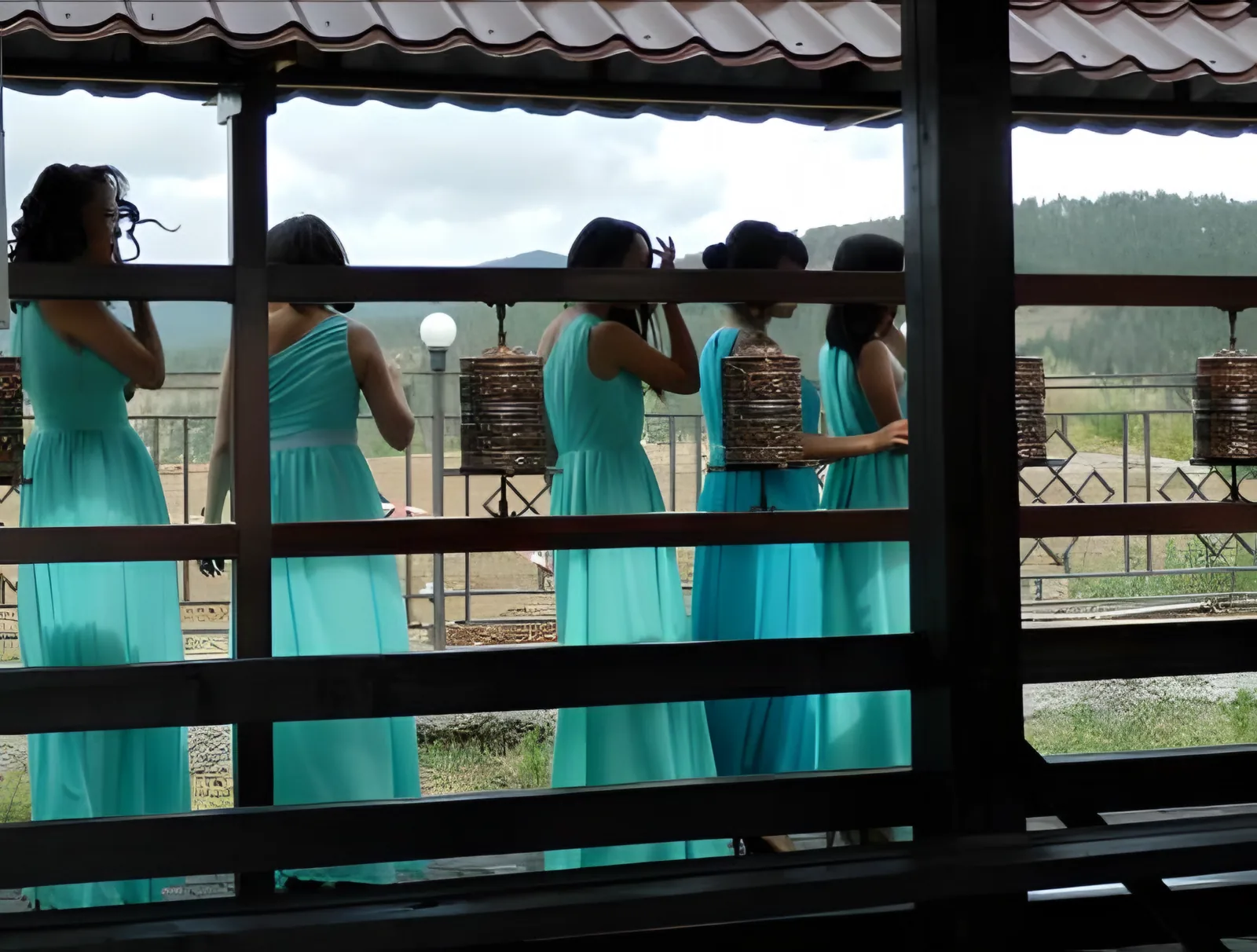
Prayer drums are turned in order to send one’s prayer out into space, and somewhere upward to the Great Power, the one that knows what is best for us… For in truth there is only one ideal prayer, the formula of an ideal relationship with Power. Here it is: “Lord, give me the strength to accept what I truly need”. In this address, in place of the word “Lord” everyone can put their own variable close to their heart, from the infinite multitude of names of God.
In the Buddhist tradition there is no personalised god; everyone who attains enlightenment becomes a Buddha. I understand this as though he were becoming the Template of the Human Being (the perfect template) in the high sense of those words. Yes, yes, precisely the one who was created “in the image and likeness…”. And there is no single correct wording of this creative act. Whether God created man, or man created God in his own image and likeness. In this formula lies the algorithm of our striving for perfection. And if the formula is written correctly, then here, as in mathematics, the essence expressed by the algorithm doesn’t change if you swap the right and left sides of the equation.
Life is a lesson in which the Human Being becomes a Buddha, and on the other hand, we are Buddhas who are learning to be Human.
It is good for people to remember that you cannot become a human being once and for all; you have to become one every day, again and again.
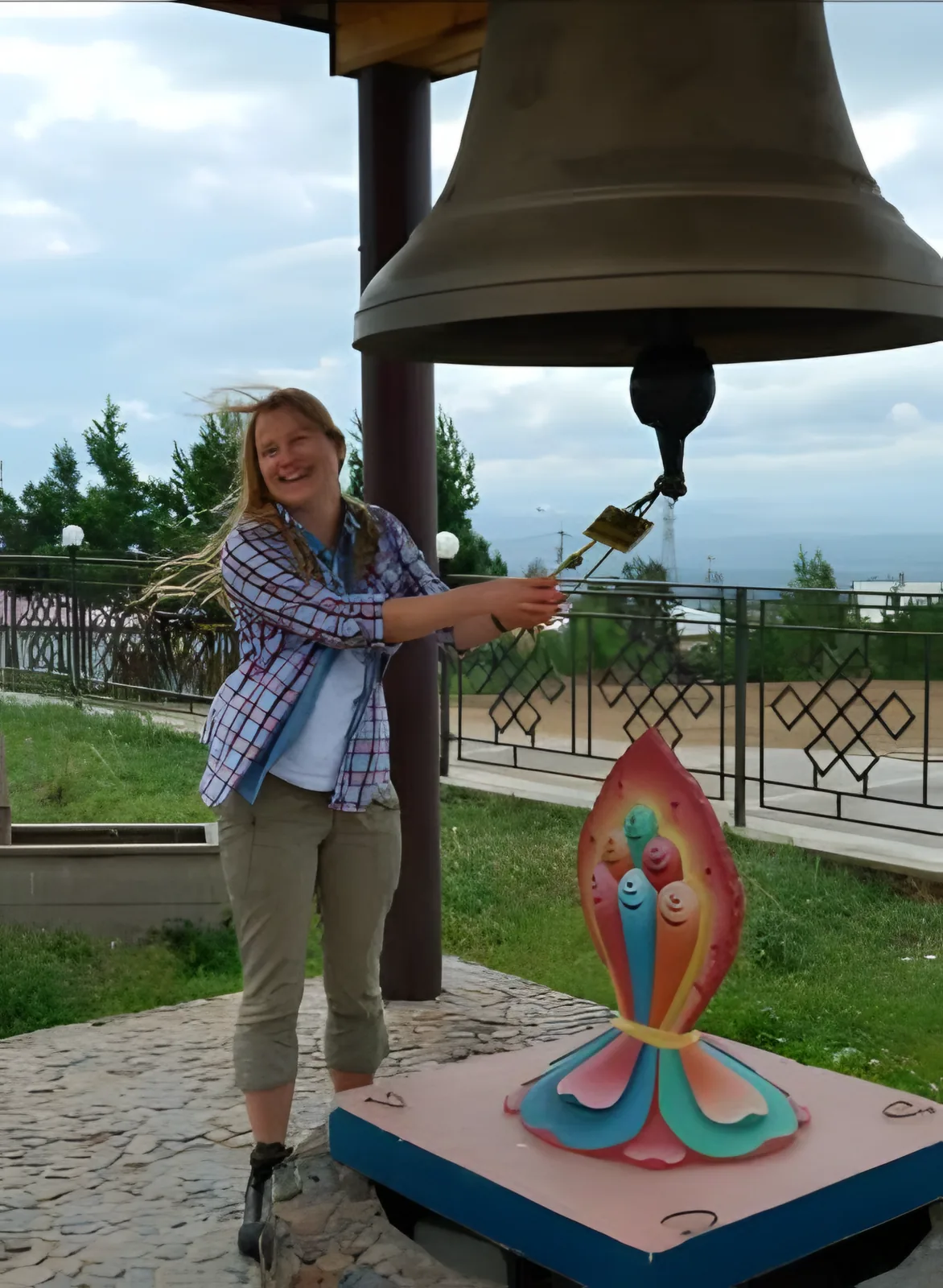
Where to move? That is a question of our lofty meanings, or, to put it more simply and clearly for most people, of our desires. For the ordinary person, the turning of prayer drums is done in order to make a wish, and we, the participants of the journey, can also sometimes allow ourselves to be ordinary people… For lovers of wish-making there was a huge bell (a metre across). A thick rope was attached to its clapper, allowing you to swing it and, announcing your intention to the surroundings, send your wish out into space, thereby performing an act. Perhaps the first in a chain of acts leading to the realisation of what was planned.
How are our meanings connected with our desires? Our meanings are the parents of our desires. The nature of our desires depends on our life orientation and the scale of our meanings, yet desires are a more tangible category for a person. Let me name the varieties of our desires, dividing them into categories so that it is easier to communicate with them:
– childish,
– social,
– personal,
– beyond-personal…
… I am hinting at the different sources of meaning from which they originate. The sources of our desires are our basic needs, which are our roots reaching into the sky and/or the earth.
Before setting off for the lake we went into the monastery, where a service was under way, which to us looked very much like a shamanic ritual. Golden Buddha-deities frozen in their movement, living people in burgundy robes, synchronised in their chanting and actions, and we, the motley and chaotic visitors – like three forms of life. Each of those who enter at the moment of the ceremony falls silent about something of their own, and having switched the settings of their state, leaves here more collected, whole, carrying within a little piece of the silence of the egregore of those who have attained samadhi.
Having swung the huge bell and released their cherished wish on a sound wave, each of the participants, with a distinct feeling that the “beginning” had taken place, would climb into the minibus in anticipation of meeting the Lake.
Colourful young lads, the driver’s friends, would ride with us all the way to the shore. Their life scripts contrast with those of the Buddhist monks, so these guys organically balanced our idea of the local population with a bold stroke of their selfhood.
The driver was the calmest of them. Yet he too, like all the locals, has a highly developed mystical consciousness. The attitude to the Lake is personalised, as to a living Miracle, a living, self-organising and very influential Power. He told us that although more than 350 rivers and streams flow into Baikal, naturally running through inhabited places, the water leaves it cleaner than in the big rivers that flow into it. And in the end only one single, purest river flows out of it, the Angara. The locals revere the self-cleansing lake like an altar, mention its name with respect, speak of it as of a living person, and do everything that helps clear its shores of tourist raids.
A young Buryat “delighted” the participants by demonstrating to us the local tradition of dissolving one’s emotions in alcohol. Young, emotional and superstitious, he had managed to divorce his wife the day before and so drank wine from a carton all the way: whether from happiness or from grief. Asking the driver to stop at every crossroads and every rise in the road to appease the spirits, the Buryat poured a little wine into a cap, carefully laid a coin on the ground and talked with the spirits. He told us about local traditions, was surprised at our gorgeous blonde’s remark that wine is better drunk in a good restaurant, and, treating her to pine nuts once more, went on:
– If you don’t “chat” with the spirits, the road can turn out nasty. All the knowing Buryats do it – they share their drink with the local spirits so that the road runs smooth and the weather and the car are allies on the way.
This Buryat is a descendant of a local shaman, and his own uncle is a lama.
It must be said that every tenth man in Buryatia is a lama. A lama, like a teacher or a shaman, for example, is in essence a different hypostasis of the local priestly estate. This lad’s family life fell apart almost before it began, because his traditional worldview diverged from the worldview of his far too modernised young wife.
The guide’s friends had been taken along by him at the start of our journey to help with buying provisions.
The third character in our escort, besides the driver and the young Buryat, surprised the group even more – because we drove for more than 4 hours, and he too was “chatting with the spirits”. And in the course of the journey he managed to propose to our Anya. She said:
“No, thank you, but I approve of your choice” … which greatly saddened the lad.. On arrival the upset young man bathed in the waters of Baikal fully clothed and walked off into the night, barefoot, on foot to Ulan-Ude – a mysterious, wide Siberian soul. His friends, who knew him, told us not to worry, and that he would be all right.
In spite of – or rather, precisely having looked at the driver’s friends – we liked our guide even more; he won our trust: simple, sensible, reliable, and you could see that he wanted (really wanted!) to show us Baikal.
As we approached the first point of contact with the Baikal shore, I handed my phone to the guide in order to navigate a friend of mine who “by chance” happened to be in these parts, and “by chance” found out that I would be here too. This person once “by chance” saved my life, and so I regarded his appearance in these places, at this point of space and time, as a sign.
A week before the flight this man called me (a mathematician known in world scientific circles) and told me happily that 70 km from the place where our expedition begins, a mathematical conference would be held. I knew from him that conferences like this take place in different places in the northern hemisphere, but right now it happened to be at Baikal, and exactly at the point near which our group’s route runs! A miracle?…
This mathematician is more than a friend to me; he is a person to whom I owe my life. That is a completely different expedition and a different story – but I will still tell a piece of it here, because this person is, by his very life, very significant for me.
We met in 2010 at an altitude of 5,000 m on the trail to the eastern summit of Elbrus. During the climb I was left alone, without strength or warm clothing and, freezing, in a wonderful blissful state, was already falling asleep on the trail, watching rainbow prominences – the effect of “gornyashka”, the so-called oxygen starvation typical of these heights. Then, like a mirage, two good fellows came down to me from the summit in seven-league strides, in crampons, either archangels or rescuers. One of them swore heartily when he saw me alone in my state on the trail.
The men were old friends and seasoned mountaineers from Nizhny Novgorod. They set me on my feet and, supporting me under the arms, set off rapidly downhill. In this situation it is important to lose altitude as fast as possible, and also important to talk so as not to lose consciousness. After several hours of walking and lively conversation, after a good ten kilometres across the icy cap of Elbrus, one of them, leaving me (because his plane was in 8 hours) warmed up and safe beside my tent at 4,300 m, said, pressing my hand warmly: “I will find you, and you can find me… on the internet… I have a well-known name – Andrey Mironov, only I’m not an actor, I’m a mathematician…”
Four years later our paths crossed again, also by chance, and also for only a few hours (because the plane is in 8 hours), only now on the shore of Baikal. In the evening the members of the expedition would be treated to the mathematician’s gifts – a fish called omul. It is the main local delicacy – a Baikal endemic. And my friend and I would go for a walk in the forest and talk as if we had never said goodbye and had known each other for a thousand years, about families, children, and of course about the journeys and climbs that had taken place over those four years.
I will listen to him and try, as we go (between discussions of routes for climbing five-thousanders), to find out how it is to be at once a mountaineer and a mathematical genius – to fly off to some Japan or Germany to think with fellow “Einsteins” over a problem that has no solution? And so all one’s professional life – it’s amazing, isn’t it!?
When we humans are passionately busy with one thing, one investigation, all racial, religious and sexual prejudices vanish – when we are in Spirit, everything external ceases to matter except the task of making manifest the unmanifested.
I will watch and wonder at my thoughts: since this man, who has a bearing on my fate now, has again by chance, in some mystical way, found me at the other end of Eurasia, he must symbolically be my “mirror”, and this means that perhaps I too am “solving a problem that has no solution yet”…
Chapter 2. Knowing Power through the Name of Power
In the morning our guide will wake the group with the smell of hot cocoa brewed on the campfire. The sun will rise behind the forest, we will climb into the car and drive along an alluvial sandy spit to the jetty. From there a motorboat will take us to the farthest point of the peninsula, where the little seals love to frolic. There we will land on the shore, and, inflating his raft, the guide will teach lessons in rafting – that is, paddling, assembling the raft and behaviour on the water – to those who are not yet in the know. And we will paddle all of that way back by ourselves over several days, stopping in any picturesque place that draws us, for meditations on beauty and on ourselves in beauty. Gliding along in the breeze on the motorboat, we greedily took in the relief views of the shores and listened to the guide’s commentary: “Now we’re passing a village that lives without electricity; there are about 200 people in it and they’re fine there… Here we’ll sail in to the hot springs… Here we’ll make a long stop, there are lots of berries here, over there are islands where seals gather in spring, and this island is a paradise for cormorants…”
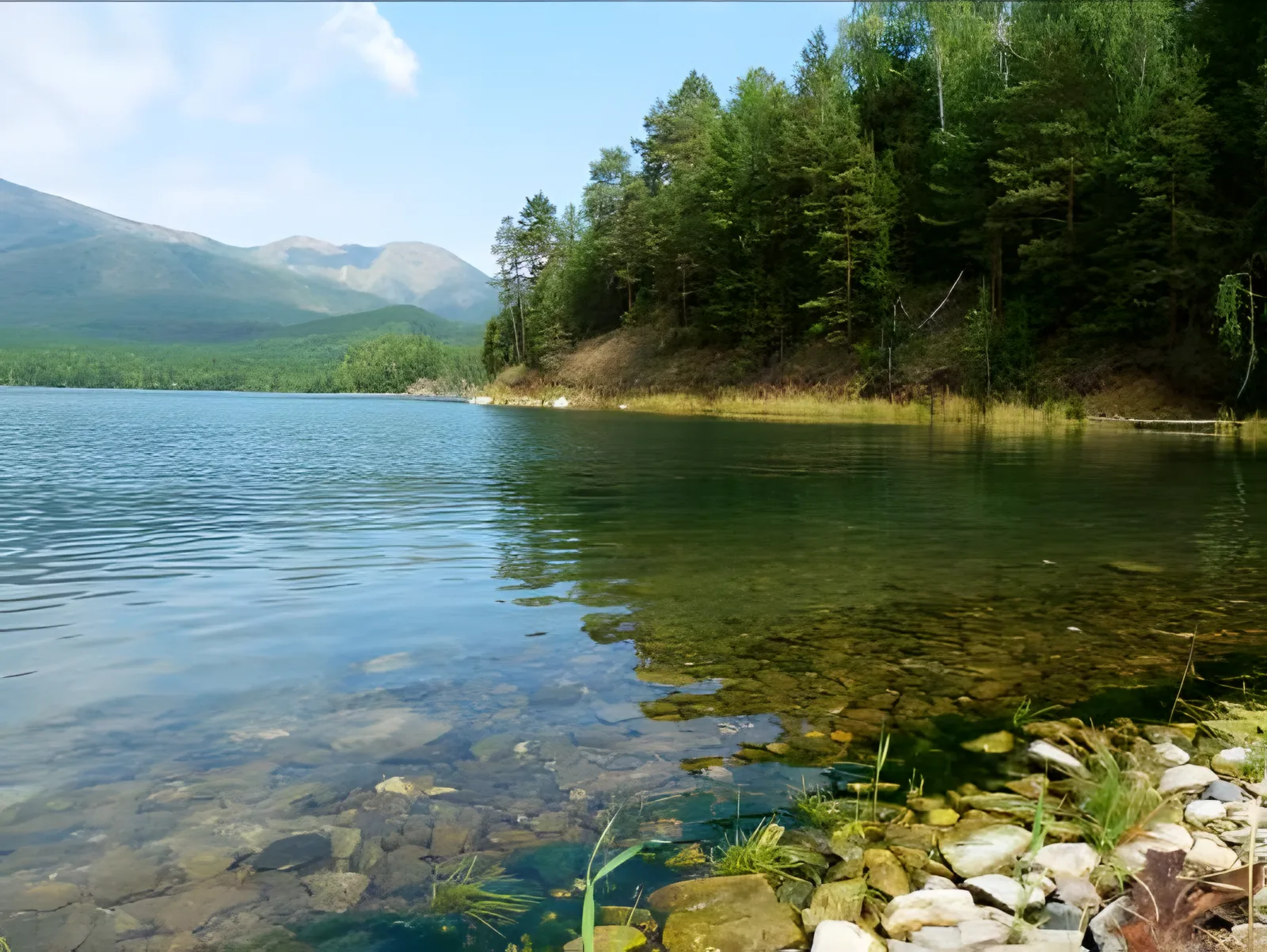
Arriving in an amazingly quiet lagoon, stepping down from the gangway barefoot, wiggling our toes in the water, we couldn’t stop marvelling at how water can be so transparent. Having unloaded us, the rucksacks, the food and the rubber catamaran raft, the little boat turned and sailed away.
Annushka and I froze at the primeval beauty of the protected forest: birch groves, cedar-covered hills, pebbles scattered in the water as if under glass, a shoreline pale as cane sugar, and stones… such stones… that you want to take them all away at once. So, after standing a little, without agreeing on it, we thought one and the same thought in sync: to swim… right here, in this wild-wild place, and naturally naked.
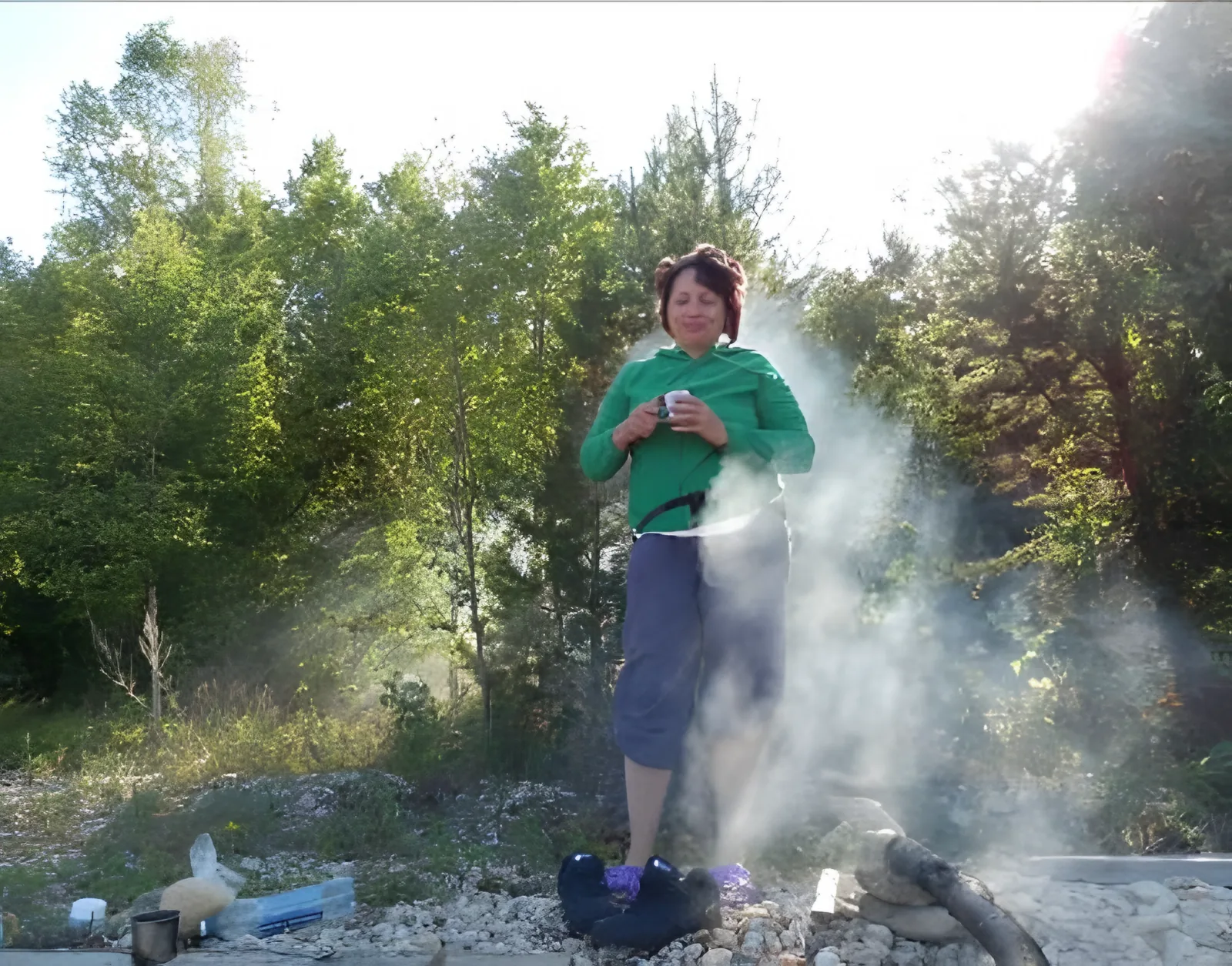
Having picked a spot for the fire and pitched the tents, within an hour, happy at the beauty around us and full of simple food, we sat down in a circle to rename the participants, for a fresher contact with themselves on the journey.
It is an amazingly effective tradition that has taken shape in our development laboratories, and it is especially good for journeys to new places. Setting aside for a while their worldly name, a person manages to rest from their social self more fully than if they were still called Vanya, say, even here. Their journey will go much deeper if they are, for example, Free Wind or Taiga Cedar.
But the tradition of choosing a name is not as simple as it may seem at first glance. The beauty of this process is that all the participants take part in choosing the name, and this alone gives the one being named a different vision of themselves and of the facets of the meaning they are trying to pack into the word of their new name. I call this practice the Naming by the Actual Name. By searching with the group for the most actual emotional movement of this person’s soul, we let come out the most important quality that is needed for them, right now. That is why the names come out so alive and strong – in themselves they already doom a person to renewal and development. And often the result of the group’s creativity surprises not only the one named but all the participants.
And after several hours spent vividly in the centre of the circle, after amazing I-stories, we got to know each other better than spouses can know each other in about 5 years. The social individuals with serial names disappeared, and “people of the tribe” appeared, with unique characters and an amazingly unrepeatable pattern of life.
SASHA – Dancing Thunder – is a mature businessman, an educated and very gallant man; long ago (some 20 years back) he watched a documentary film “The Lake” about Baikal and now was fulfilling his old dream. He came here for Power for a new stage of his life.
MARINA – Barvysta Veselka (Colourful Rainbow) – is his woman. In the past a master of sport, active, strong, businesslike, self-determined. And probably because of an excess of these qualities she has a complicated relationship with her daughter. Here she is after lightness, fun and the colours of life.
LENA – Gorgeous Woman. Married. A beautiful woman who looks like Kim Basinger, with a girlish, eternally young smile – now a traveller and yoga teacher, a psychologist. Loving life, company, flirting. Sweet and incredibly hardy, a coquette. All through the journey she will entertain us, testing the stamina of the men we meet on the way 🙂
VLAD – Giver of Meaning. Our guide – a true man of the taiga, the son of military parents, who grew up in these parts from childhood and has all the survival skills of the taiga; even bears could envy his virtuoso climbing of cedars for cones. Unmarried and slightly shy. Otherwise reliable, confident, enterprising and incredibly practical – out of whatever is at hand he seems able to make anything: furniture, a fire, food and a reason for stories. Only sometimes at the campfire his reflections on life betrayed his young age: dreams of an “El Dorado” combined with a certain disappointment in people, rather in men, apparently those with whom he had unsuccessfully tried to do business.
ANYA – Shamaness – a young woman with a complicated fate. Mother of a talented son. In love. Delicate, keenly feeling the emotional states of the people near her and sometimes the events that precede them, seeing prophetic dreams. She is here for her genuineness and for the freedom to boldly show her depth. She wants to express what she feels without looking back, not worrying that she may be misunderstood or may hurt someone with her inner truth.
I – Vangara – I had a request: to understand more deeply the nature of Baikal’s pure water, through contact with the one river, the Angara, that results from it, flowing out of the lake cleaner than everything that flows into Baikal. My name was chosen by the tribe after hearing my story and my meaning.
At night the full moon rinsed its moon bunnies in the calm waters and lit the beauty of Baikal until morning. In the morning we “yoga’d” on the shore and, refreshed, wandered off, some to gather firewood, some to assemble the catamaran, planning to set off for the next bay in two hours.
In the taiga in August it is sunny and not hot, and that is a joy. The guide said we were lucky: the water this year was unprecedentedly warm – 20 degrees! Usually it is 12–16 degrees, which allows a quick, reverent dip and straight to the fire to warm up, but we could even swim for a while – that is how lucky we were!
Having pumped up two rubber “bananas”, we fitted an aluminium frame between them and, lacing it with tarpaulin, built a raft/catamaran in under an hour. What I especially liked was the engineering solution of the designers: the inflatable craft’s valve where you pump in the air closes with a cap identical in standard to the cap of a plastic bottle. Even if hapless tourists lose the cap from their little boat, they can always replace it with the cap of any standard bottle and sail on.
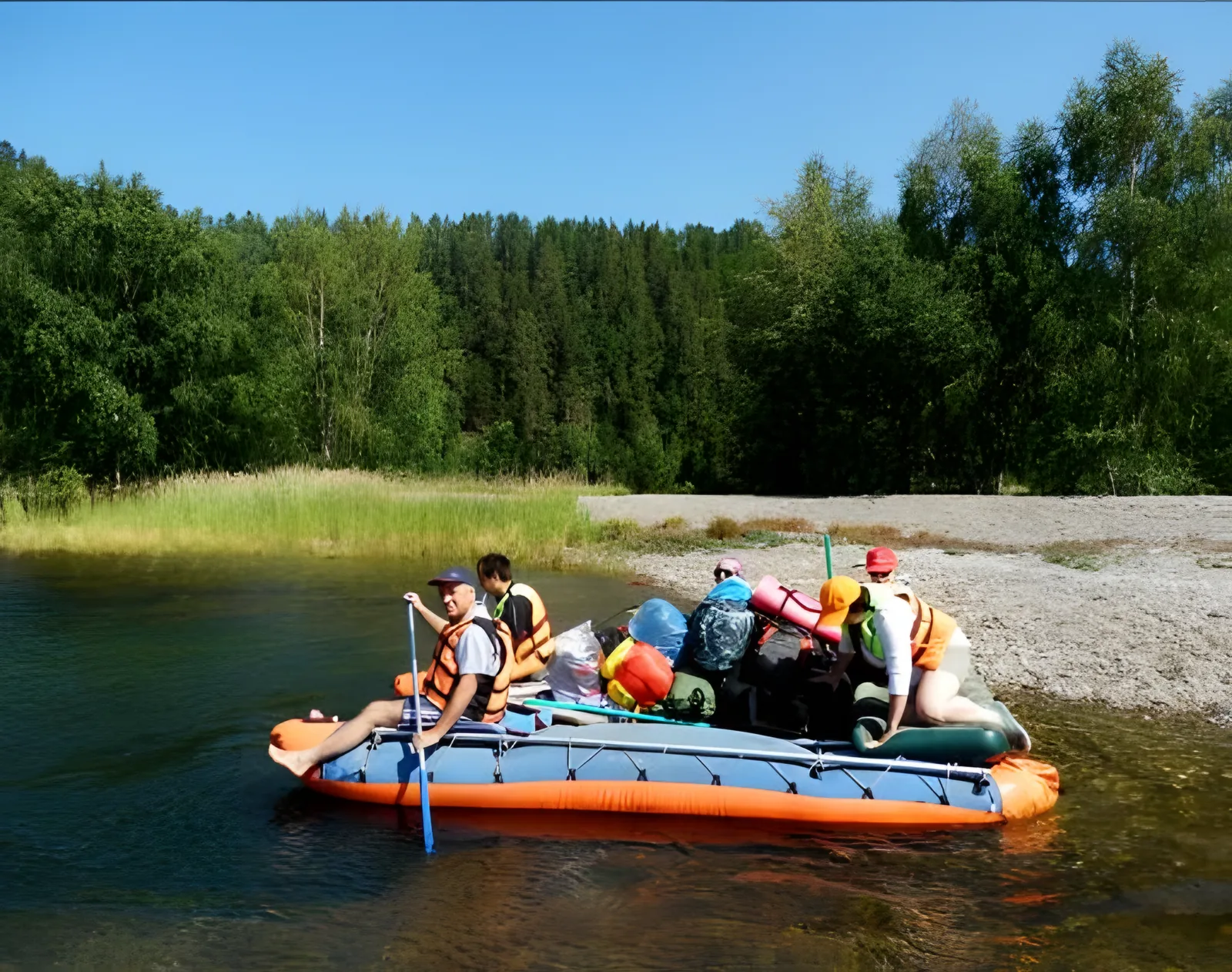
Another important and wonderful solution for a water journey seemed to me the sealed plastic container into which we prudently loaded all the camera equipment, documents and phones (the phones, I should say, we had agreed to switch off and not use until the end of the journey); yes, such a container really doesn’t sink – it is sealed, so the air inside keeps it above the water like a float.
The first crossing is a task of attuning to each other the two polar sides: right and left. The guide seated us at the edges of the raft, distributing the six of us between the two bananas. And we, delighted with the childlike emotion of anticipating an adventure, very focused, swung our paddles, first out of step, and then in sync, smoothly and with songs. After about three hours we were already mooring at the next lagoon It was a wonderful idea, the catamaran! You can feel the body of the lake so closely and literally precisely if you swim across it for many hours, literally by your own strength and your sense of direction, which overcomes the perpendicular or any other direction of the lake’s natural currents.
The shore was longed-for, and drew us to it like a magnet for many hours. We stepped onto it, tired and happy from the strength awakened inside and from merging with our literally steady goal – the solid earth.
Having come into contact with earthly steadiness, we staggered for a while longer – just as in life, when we get used to the unreliability of people, for example, and the tossing of events, we get lost on meeting firmness and reliability, and then it begins to toss us. This, by the way, is how girls often “accidentally” spoil a relationship when they meet a worthy man – the force of inertia. Only heightened awareness helps to resist inertia and automatism. That is, it is useful to distinguish your reaction to events from the events themselves. Most people have the illusion that the causes of their states are conditioned by the external – by people, by circumstances. Not quite: external circumstances and people are only buttons – while the processor of reaction is inside, and until the version of oneself is updated by the owner himself, these “buttons” will keep launching the old programs.
Awareness is not control over those around you; it is attentiveness to your own inner processes and ways of reacting.
We planned to lose our tents in the forest so as not to attract the coast guard. We were in protected places where tourists are officially not allowed, but our guide had been chosen precisely because he knew how to show us wild Baikal. Choosing a spot for the tent, Shamaness came upon bear tracks in an anthill. This both pleased and frightened us at the same time. Yes, meeting Power, a person often cannot decide at once which of the feelings surfacing simultaneously at that moment to choose to feel – feelings whose names are Delight and Fear. These emotions compete for the attention of the lucky one who has run into a great Power.
It is far from immediately clear even to him which will win inside, and of course what wins is whatever corresponds more to his nature. But even if Delight wins, Fear stays there in the background. Fear remains, it goes nowhere; being there, in the shadow part of our personality, it serves as fuel for our delighted enthusiasm. And the other way round: if Fear wins in a person, Delight also stays there, on the back streets of consciousness. And that is exactly why people still attract the situations they fear. They attract what they are trying to run away from. The hidden Delighted Admiration standing behind the back of Fear pulls them to come into contact once more with these circumstances that are so amazing for the psyche. This process of active “fearing” I call negative Enchantment. Because in any case – whether Delight or Fear is in first place – there is contact with Power here. And to desire contact with Power is not just the highest human need – it is the need of Life itself; to be more precise, it is the need of our Spirit: to seek contact with Power by approaching the boundaries of the known, in order to go beyond them.
At the root of the word INSPIRATION (in Russian, ODUKHOTVORYONNOST) lies the root “spirit”, and it is this very process – contact with Power – that makes us alive. This is the secret of enterprising, life-affirming people: they are not afraid of Power, they seek it, they are in Spirit, and they constantly strive to widen their limits and cross boundaries. During supper we eagerly discussed versions of how it would be best to “meet” a bear, what to talk to it about (maybe politics, maybe sing it songs) and in what voice. The participants started a debate, modelling bears’ attitudes to different topics, dialects, folklore and Russian swearing. Watching one another’s creative flow of ideas on this, and listening to stories from the guide’s life, we came to a rather deep conclusion – and it pleased us.
If, on meeting a bear, a person manages to remain a HUMAN BEING, calm and curious, as if he had stayed “the crown of creation”, that is, if he did not collapse into animal fear (which of course is unlikely in practice), then the bear will not be dangerous and will prefer not to get involved with the strange creature. But if a person is overwhelmed by Strong Fear, then this feeling, understandable to any large animal, will surely attract the bear, and he will see in the person his food, or a weak rival, or whoever else a bear might suddenly feel like eating so as not to suffer.
My observations say that nothing and no one in a Healthy world and society wants to be feared. When we are feared, and we see that we cannot influence this feeling in the other person in any way, we too begin to feel a vibrating feeling inside, mirrored – anxiety or aggression – that we want to get rid of quickly. So that there is no fear “humming” nearby. To get rid of the unpleasant emotion and of the person who carries it.
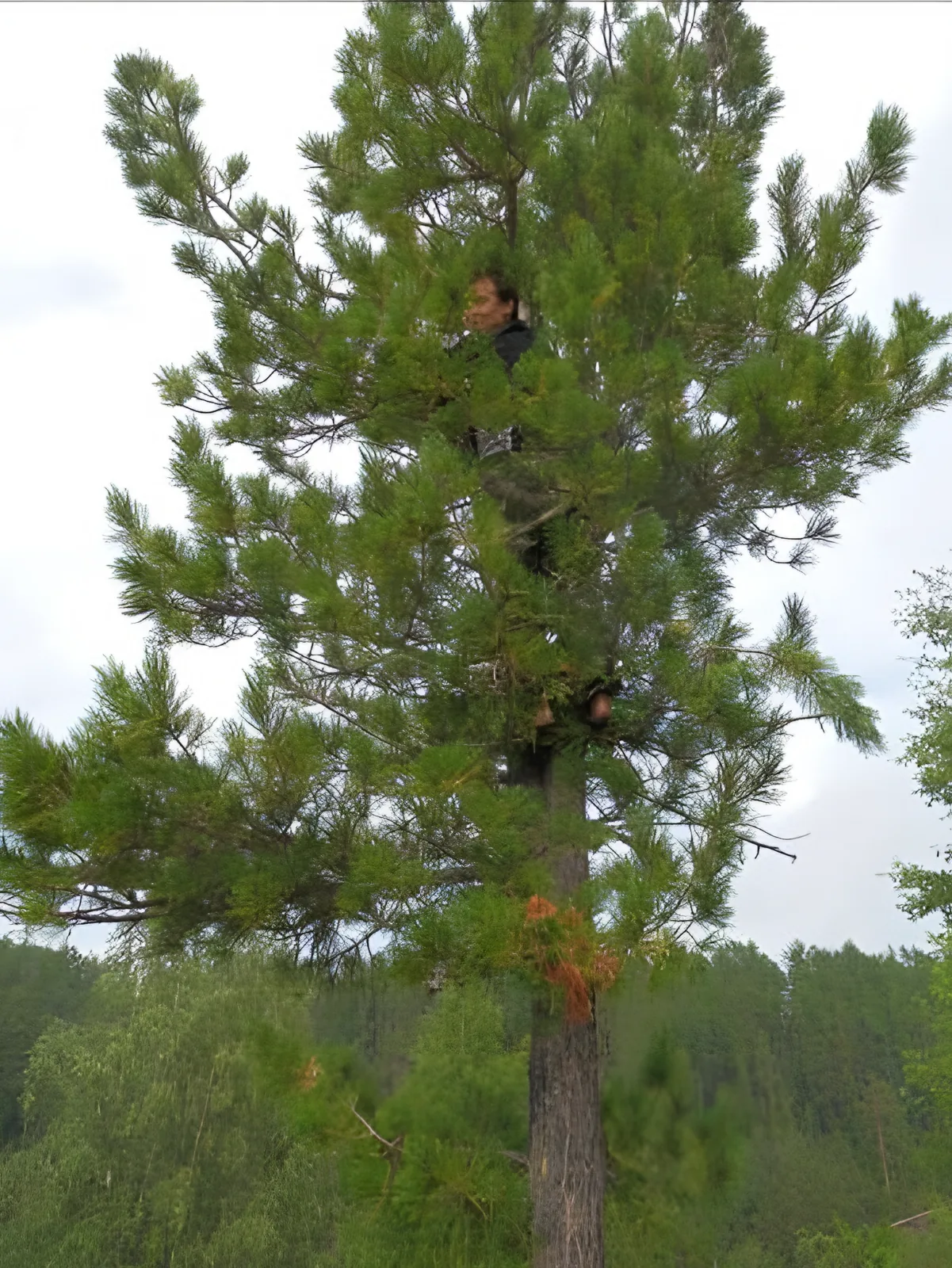
The guide walked along the shore, shook the cedars, and checked by ear the ripeness of the cedar cones.
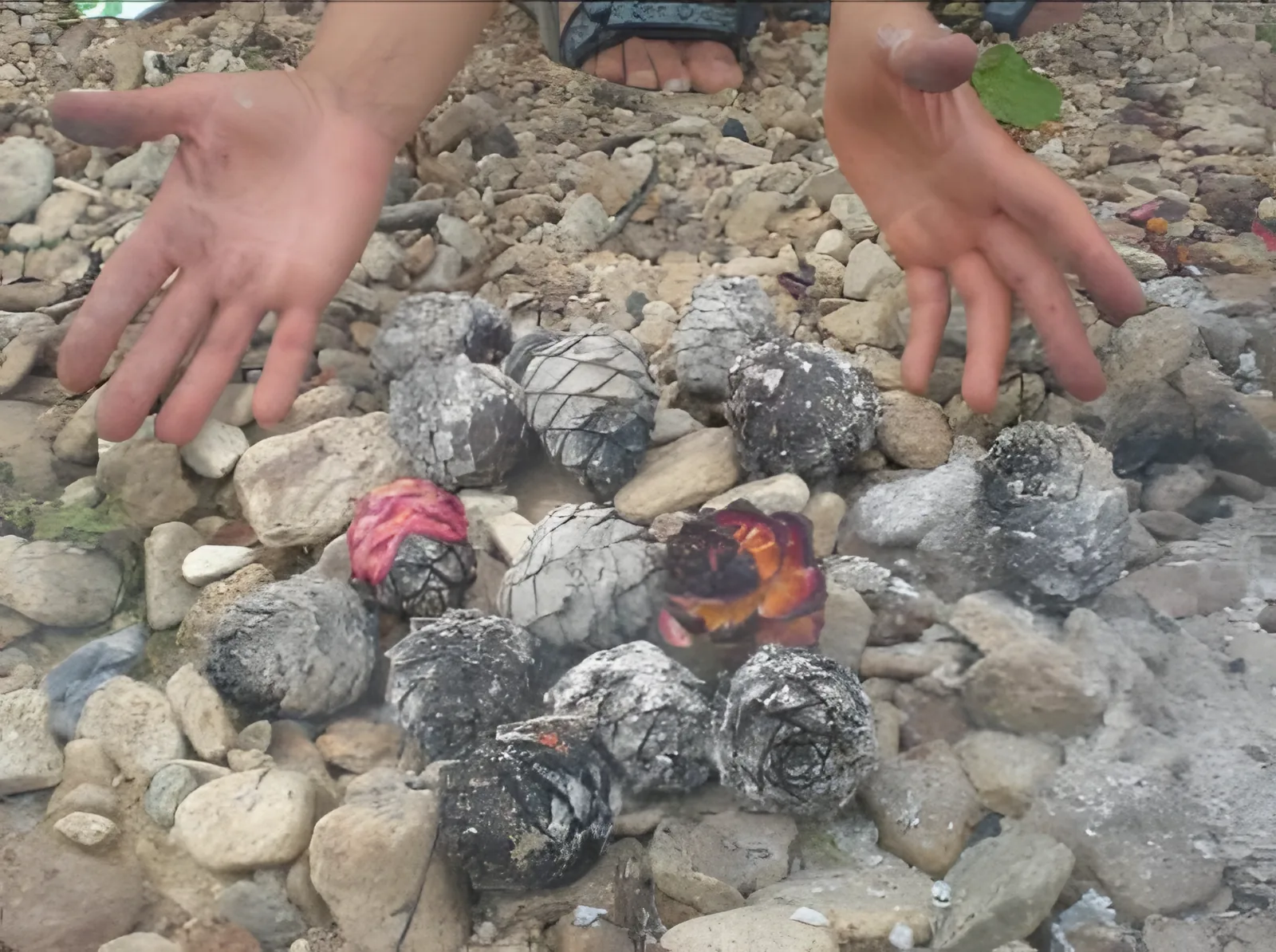
– They’re almost ready; they can be roasted on the fire, they’ll open, and you can eat them.
When he lightly soared up the tree and practically got lost in the lacework of needles, nobody had any doubts – that is surely his power animal – the Bear. He even looked like a bear, in build and in his pigeon-toed gait; how could we not have noticed such an obvious resemblance before?
And if so, then we need not expect trouble from meeting this animal – the guide’s totem is our ally!
In the evening the idea arose of meeting the sunrise. But the ideas of yesterday (especially evening ones) don’t always turn out to be relevant in the morning. The sunrise was “purring” to me very much, and so, seeing the sky turning grey, I came out of the tent and began feeding twigs to the smouldering embers on the shore.
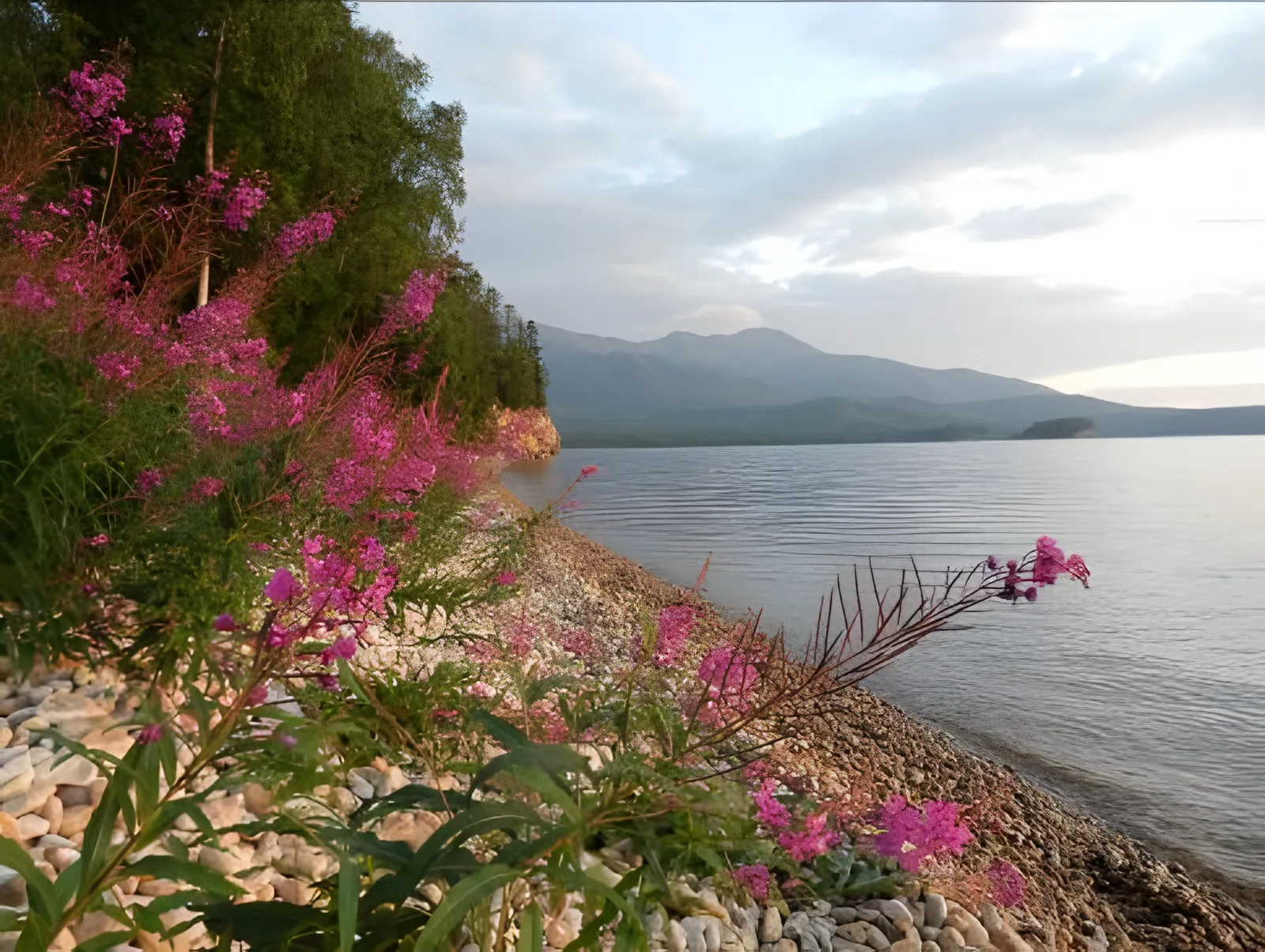
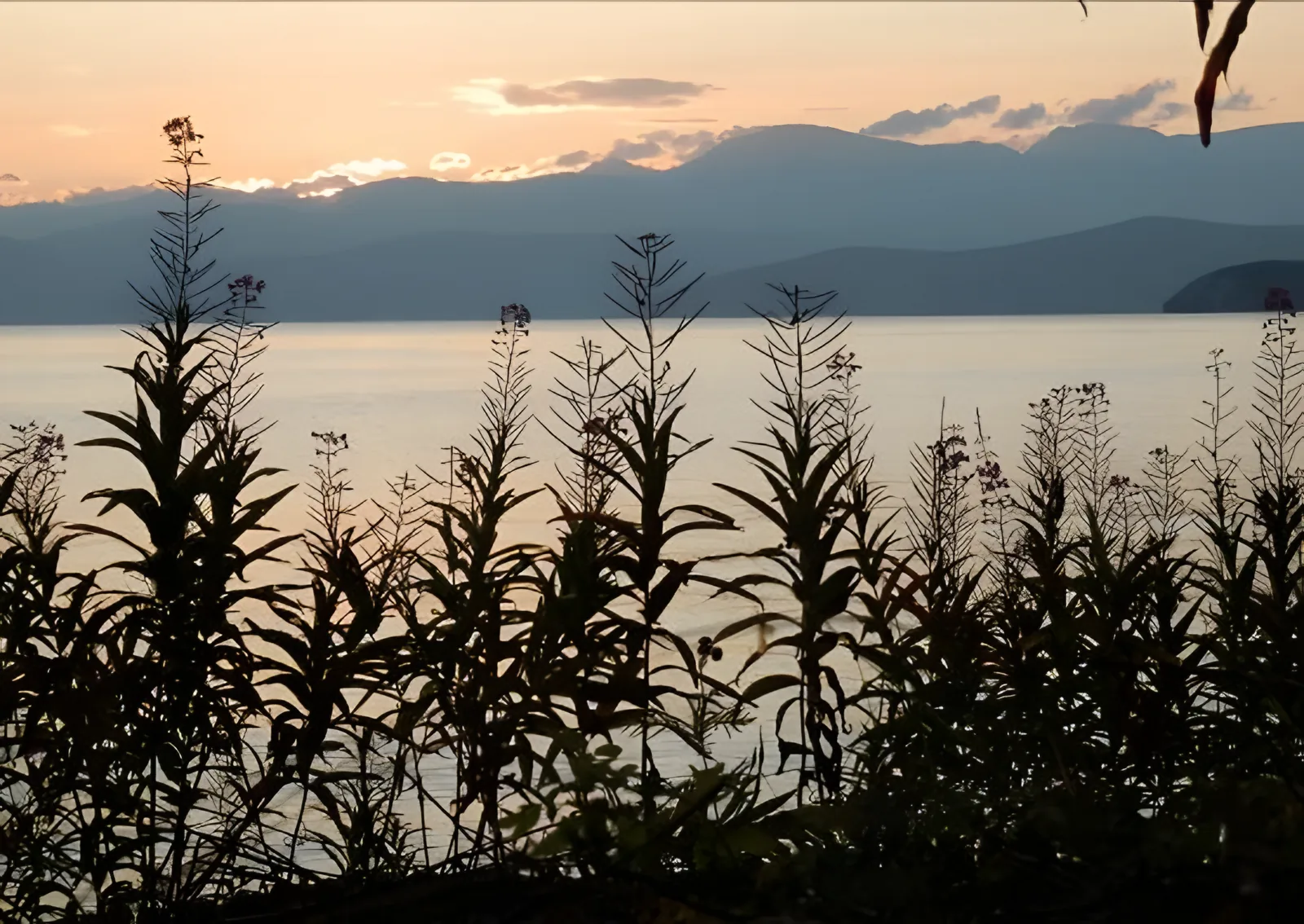
The sunrise was long, but I convinced myself, and will now remember well, that the sun here rises and sets differently from Africa. In Africa it quickly “switches on” the day, and in the evening (at exactly six o’clock sharp) it simply drops over the horizon, and almost at once a dark tropical night falls – the light goes out instantly, as if it had been switched off by pulling the plug from the socket. Here it is all different – the sun rises for a long time along the horizon. Its orbit is very slanted, and so we waited two hours for the sunrise. The sun rose not where it first began to dawn. No, it teased – it crept below the line of blue mountains, far to the south, and there, not at once, but first touching with the pink rays of a stray cloud, it showed its crimson crown to the patient. To us…
Chapter 3. Crossing to the island and a very berry place.
In the daytime we broke camp and loaded up, distributing ourselves symmetrically along the sides of the catamaran, and sailed on. The sandy shores in view beckoned us with the cosiness of a lagoon nestled in the folds of the mountains. On the way to the next camp an island called to us strongly – quite small, rocky, picturesque, with tall grass, birches, cedars and a mountain in the centre proportionate to its size. Judging by the guide’s stories, if we were lucky we might see a seal there.
Having moored, we saw a sign: “St Helena Island – visiting prohibited”. We smiled – now it was a sign for our Gorgeous Woman. We pulled the catamaran ashore. Here the participants, by prior agreement in complete silence, scattered about the island with the aim of finding their point of Calm Power and being there alone, listening to the energies of these places, to their own meanings, and God knows what else Power may whisper to a person alone with themselves in a wild place surrounded by the purest waters of Baikal. Time stopped.
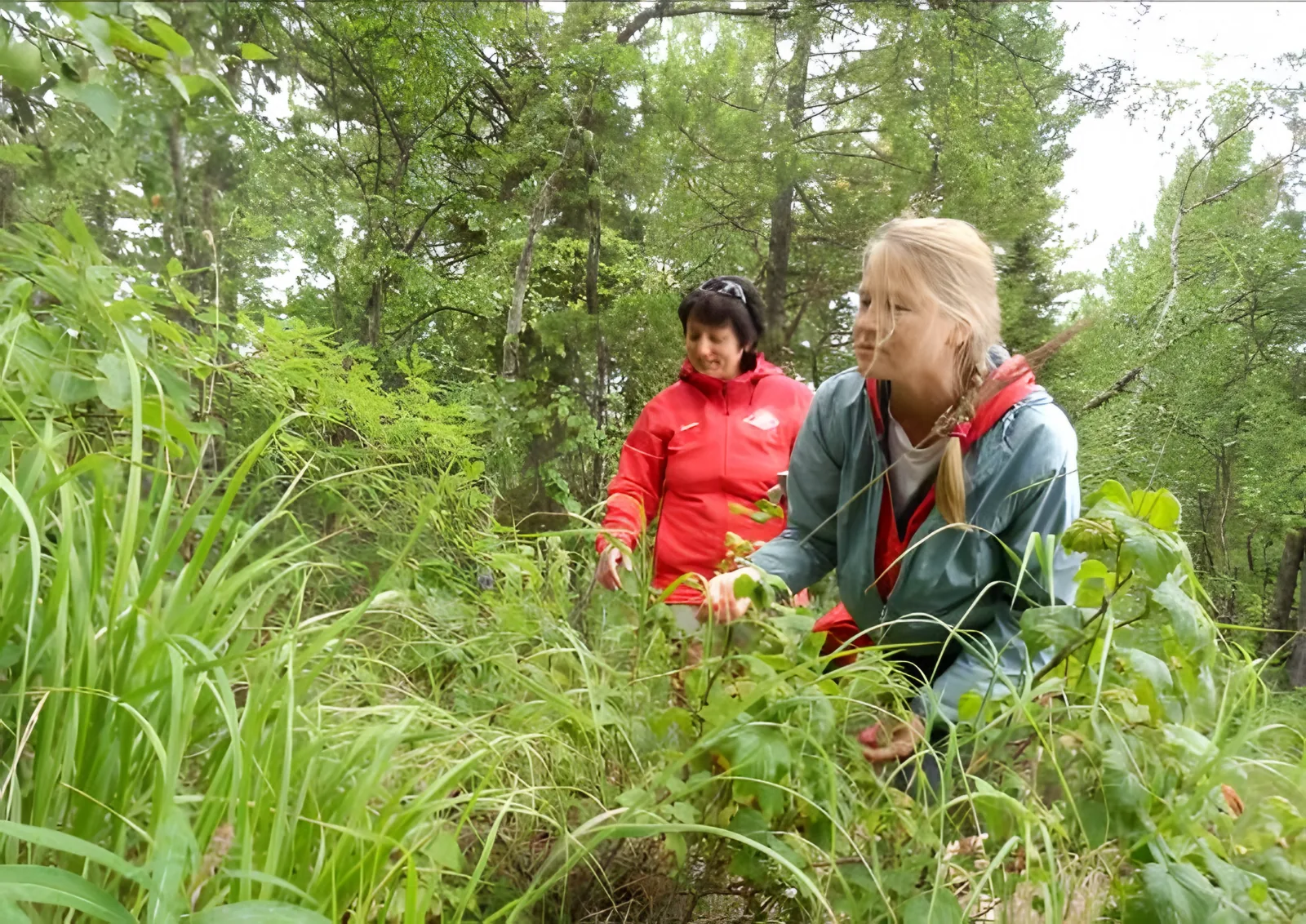
Leaving St Helena Island, we sailed on to the next camping place. We walked along a sandy beach – our way was crossed by a picturesque stream framed with forget-me-nots and bright lime-green grass. And just two metres from the water everything was overgrown with berry bushes and shrubs and little shrubs. Blackcurrant – pedigree, like ours in Ukraine in the private yards of good householders – blackberry, cowberry, bilberry, bog bilberry, stone bramble took turns at the solo, passing the baton to one another. But we couldn’t pitch camp here – this place was also the kingdom of ants. If anyone lingered long by some berry bush, afterwards they danced a “dance for the spirits of this place”, with stamping, shaking and slapping.
The ants here were serious – taiga ants, big and biting.
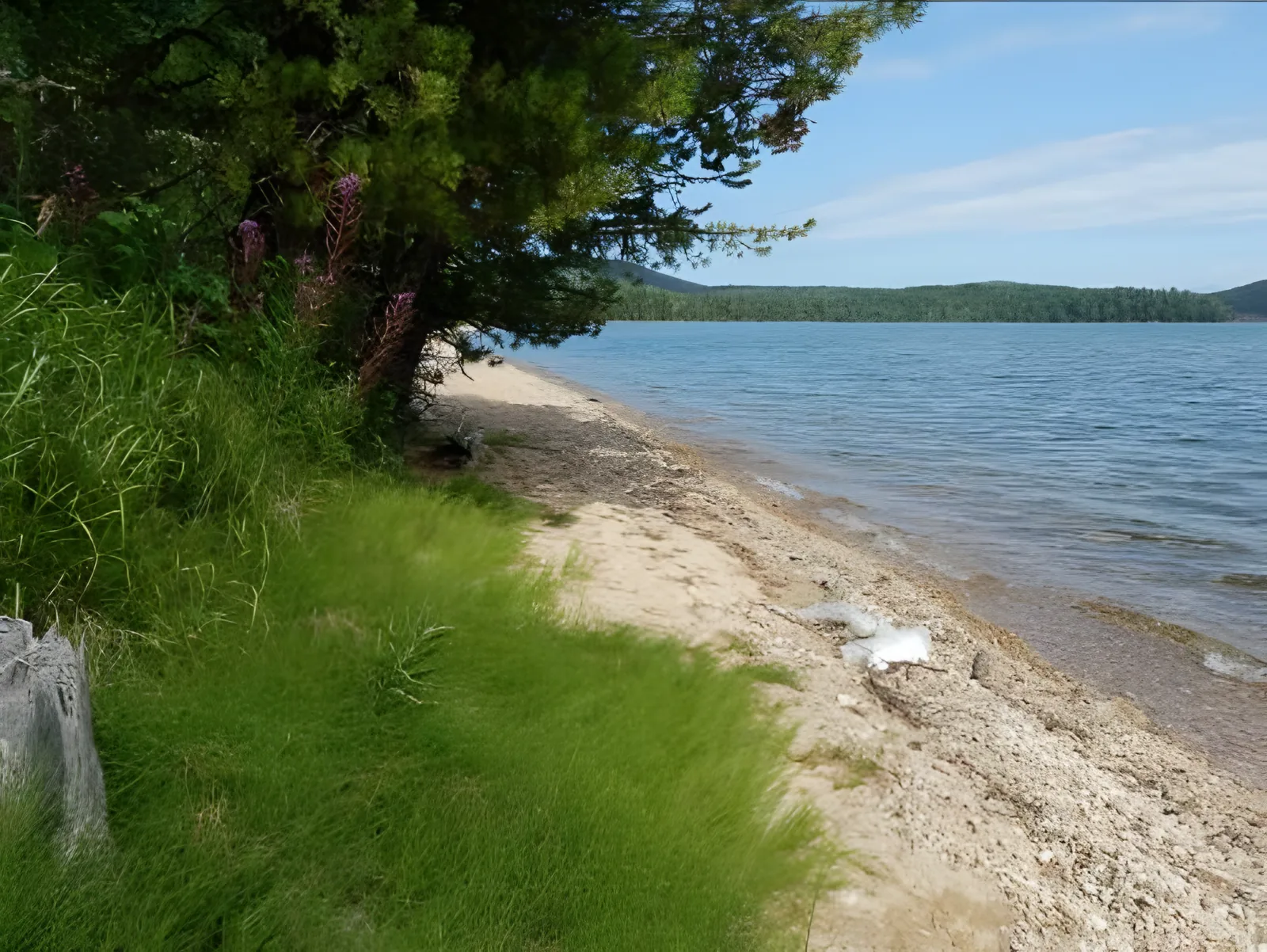
So we walked about a kilometre until we left the ant territory. The place was magnificent, with beautiful, wave-licked and sun-bleached, silvery driftwood snags that looked like installations by some stoned, terribly modern artist. These natural sculptures took such lively poses that you wanted to sit down and talk to the tree as to the spirit of the place. Trees that had lived out their earthly span and had thus, on their own, gained a second life in a new form here on the shore, inspired delight and called us to contact.
Well, soon we were sitting among them. And nearby a fire crackled, taiga cones roasted in the embers, opening like roses. I don’t know what people call “ash roses”, but this food could well have been called that – these cones, ashy outside, were all shades of grey, and pink, all shades of pink, inside. We cracked them like sunflower seeds in Ukraine. Almost in sync, the whole team, with a practised movement, took out a seed and, turning it correctly with the fingers, flicked the cedar nut kernel onto the tongue. At first it was not easy, but already in the car on the long road to the Lake the participants had begun to train conscientiously, so that by the fifth day they had gained noticeable mastery. And of course it is incredibly tasty.
Towards evening we saw a motorboat in the distance – it was heading for us. Guests – the coast guard of the nature reserve. Giver of Meaning said that since we weren’t fishing here, we shouldn’t have big problems. For visiting the Zabaykalsky Reserve we had an official permit for the journey. Shamaness had drawn it up by all the rules; it was, of course, not exactly for these places – but near them.
I said, good, we’ll talk; it’s not my first time dealing with border guards or some other representatives of authority: “– Giver of Meaning, give me the paper!”
The group was a little nervous. The paper had been made out in the name of our Shamaness – her name helped her stay unruffled, so I decided to be the one to take offence.
Serious lads got out of the boat, introduced themselves and said that it is forbidden here… I introduced myself too; I like introducing myself by my surname to the authorities, and at once taking out from my “wide trouser legs” and asking them to do the same – show their documents. I take great pleasure in reading their names aloud, a little slowly, as though I were trying to memorise them.
But they said again – “that it’s forbidden here”.
And we showed them the paper and said that for us it is allowed. They said it’s allowed, but not here; here’s the map, and right now you’re in a zone where it’s forbidden, look, on your permit this section is marked as forbidden. And we said, if it is on our permit at all – it means “allowed”. And we looked at each other like real blondes. The reserve guards insisted “that it’s forbidden” and did so seriously, coldly, not smiling at all, counting on frightening us so that we’d want to buy our way out. And so it was – the senior one orders the junior one, who takes out a form and begins filling in a report on the worldly name of our Shamaness about a violation.
I go on smiling carelessly and at the same time looking intently at the “bright falcons” with the direct gaze that usually frightens a person, so that he tries to look away, as if wanting to hide somewhere to get out of the sights. I never cease to be amazed, but for some reason most people, when someone looks at them like that, begin to feel guilty just in case. Although if you look like that at a house kitten that has got thoroughly playful, it will certainly, playfully and with all its zeal, fly at your face.
And I said:-
– There will be no money.
And added:
– But come to our campfire in the evening, you’ll be bored anyway.
They asked, after a long pause:
– Girls, what shall we bring you… Do you drink beer?
(Not even our guide drank beer)
– We don’t drink alcohol here – Juice and chocolate.
I wanted to let the men be heroes and give them a chance to do us some good. Though shop-bought food, of course, couldn’t compete at all with cones and berries.
When the lads had sailed off, the participants breathed a sigh of relief and spoke in a circle about their feelings regarding it. I must say that our dialogues in the Circle differ a little from ordinary discussions in the spirit of “who thinks what about…”. These dialogues happen on a different principle: “who feels what in connection with…” Yes, in us humans feelings really do arise first inside, as a living energetic response. Emotional intelligence is far older in evolution than mental cogitation “about”. Yes, regarding external events feelings arise before thoughts, and only then does a person feel the need to justify them in their head. Feelings are primary, so strongly primary that it is they, like nothing else, that make us alive – switch us on, energise us and give strength: the strength to think, too. For feelings – joy, anticipation or fear, shame, embarrassment (or God knows what else)! Even if it only fleetingly stirs us emotionally from inside, it immediately switches us on to action, or at the very least to justifying these reactions that have suddenly awakened to activity.
People unlearned long ago to pay attention to feelings, so that it may seem they have unlearned how to feel them; that is just what many of my colleagues write, but it isn’t so. It isn’t so – people have not unlearned feeling feelings, they have unlearned Living them through. I will call the wave that is born in a person in the middle of the chest by turns feelings and emotions, and although it is not quite one and the same, the epicentre of the energy wave has one location in the middle of the chest; it is certainly not born in the head.
A person socially drilled by negligent educators often avoids feelings and emotions, but they still slip through for a moment. Fearing strong feelings, he cuts off the flow by an effort of will so as not to stay in them, and begins to think them – the feelings – which gives him a clever look. But what may look like wisdom often reveals mental fear beneath it. Feelings are power, and people are afraid of power, especially their own.
So people haven’t unlearned feeling feelings; they are afraid to Stay in them. People are afraid to be present in feelings; they have unlearned how to live in feelings, considering it dangerous. They do anything not to be Present – they juggle thoughts, they explain what they have seen, they daydream or recall what was not here and not now and often not even with them. It is precisely their fear of Feelings that has developed in them a strategy: to skip past feelings, to talk feelings away – to explain anything at all, only not to stay in them.
That is, for a brief moment a person, even the driest and most callous, catches an emotion from what is happening, and at once starts translating it into the head, explaining to himself with some concept from the past his emotional attitude to (…), clothing it in words, as if he were justifying himself to himself for having a living emotional reaction to something, or blaming circumstances for his feelings. And so the living, real Present One in the person, who for a moment came alive and flashed by at the moment of contact with Being, hides again behind gigabytes of words in his head, sometimes ashamed of his fear, sometimes of his joy. As if people were unable to bear a lot of energy, and so even with positive feelings they do the same – live a little, then try to talk it away, or even drain through words what is bursting them from inside. Fear of power. Fear of admitting that I am afraid. Fear that something will happen. Fear that nothing will ever happen. Fear of wanting and even fear of not wanting.
Fear of opening up to something big: big love, big money, big opportunities. Fear of having and of not having… this list could go on for ever, and all of it will be “alibis” for not meeting Power. Because meeting Power changes you. And a person doesn’t know the new self who will appear after this meeting. The unknown is frightening.
But what if you trust Power? What if it is otherwise? If you soak up your feelings, let emotions last – then there is a lot of power. More power, more responsibility – and who wants that?
A lot of Power – an abundance of Power – is another quality and another depth of life – it is a mystery. Then the person is at the centre – he is the main “hero of his own film” – he is attentive, entirely here: because it is unknown what is around the bend, a very high state, but one has only to take fright, to lose trust: and you can learn what it is like to fall from a great height. The more there is “to lose”, the more fear.
Chapter 4. Night Guests
In the evening diving wild ducklings held a competition for the longest underwater swim. And when the sun behind our backs sank into the taiga, right ahead of us, above the thin rim of layered blue mountains, reflected in the broad strip of the lake’s calm water, the full moon rose. And the deafening silence of the evening taiga was torn from far away by the sound of a motorboat.
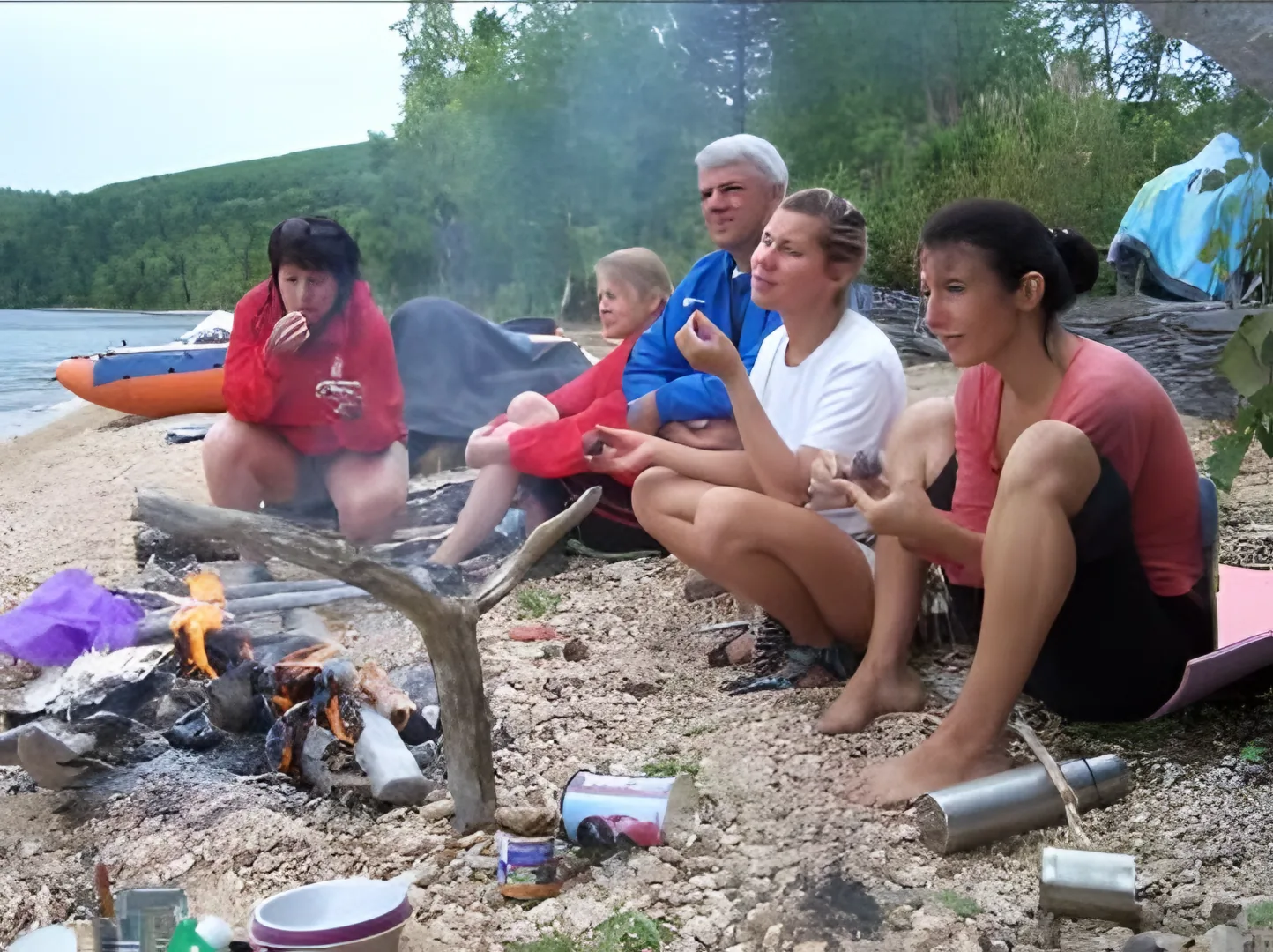
The taiga lads visited us again.
Now it was an altogether different acquaintance. I didn’t need to pretend to them to be either a blonde or a stern leader. We sat at the fire like people who have met on earth without statuses. The members of our group with their amazing names did not seem strange to them for long. Soon this “game” of names even began to arouse envy and undisguised curiosity – so that’s how it turns out: you can boldly declare to the world what you want! And, declaring it to the world, take a new name as an entry point into the desired reality, and support one another in the intention to move where is actual for us. A name is a symbol, as any word is a symbol. Though, as is well known, “the map is not yet the territory”, getting acquainted with it greatly helps to orient movement in the chosen direction, to calculate one’s strength and to replenish in time the resources that will be needed on the way.
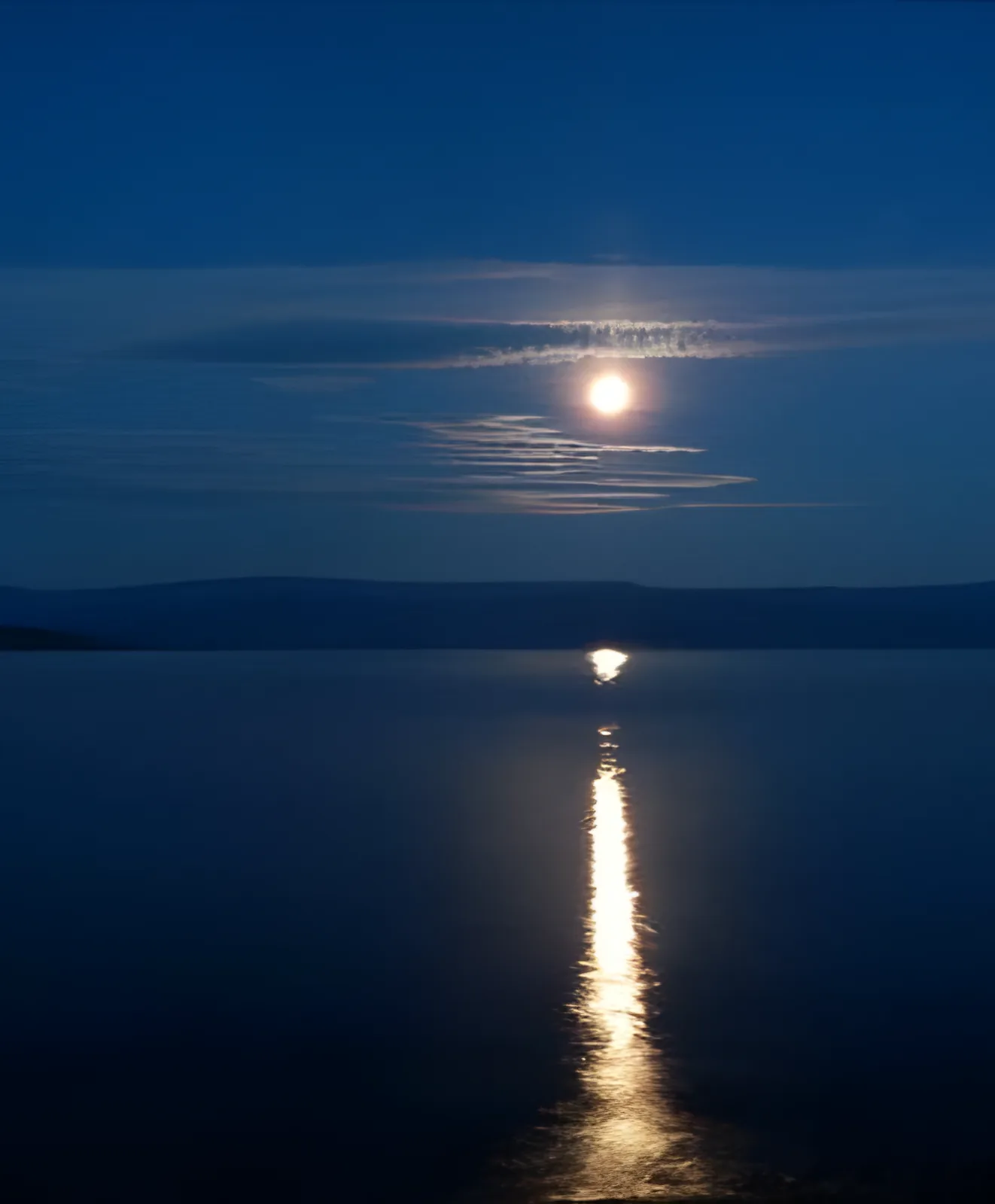
We sat by the fire in a night brightly lit by the moon and listened to our guests’ I-stories, asked about meetings with bears, and about whatever else they themselves wanted to tell us about the dangers and peculiarities of the taiga. The one who was junior in rank, and who first (when I pronounced the laconic phrase “there will be no money”) had furtively barely held back a smile, turned out to be very sociable in an informal setting. This charming young man – Pavel – talked willingly at the fire, almost without stopping, joked and listened with interest, and when he smiled he could even be called very good-looking. His superior Oleg, on the contrary, was of few words, thoughtful and contemplative – but behind this you felt such a male strength that cannot be compared with the prettiness of charming, playful boys.
They told us about meetings with the bear. Pavel told how this Master of the Taiga had recently come up to their hut and he – Pavel, being in a playful mood – went outside and started running about and imitating a bleating nanny goat, until he reached such conviction that the bear ran at the bait. His friends, who had hidden in the hut, were delighted with this experiment, with the fact that Pavel was effective bait, and that the bear turned out less effective…
They talked about the forest fires that happen here every summer. The last of them they had to put out in the taiga some six weeks earlier, and it turns out we would walk in its footsteps in a week, when we climbed to the Svyatoy Nos plateau. The scale of the burnt forest would shock us, and I would once again come to respect the lads we met in the taiga night, but that will be later.
They also told us about anomalies and inexplicable phenomena that occur in the taiga.
How trees in a small radius are twisted, or laid flat like a disc, by some unknown force. And that out there… Oleg pointed with his hand towards the farthest ridges to the east, where in the high cold mountains lives a people untouched as yet by civilisation, with amazing customs… And how in those blue mountains over there, beyond the lake, the two of them, carrying out an assignment in early spring, got lost and spent two weeks looking for the way back to the lake, out of “those places where people don’t live”.
And when I imagine how cold it is here in early spring, when the lake is under ice, I can’t help starting to tell them about my relationship with cold and altitude. About the climbs of Elbrus and Ararat, the Nepal expedition and my hardest summit of the “where people don’t live” kind – the road to Kilimanjaro.
How can this be explained to a “normal” person who looks on in bewilderment, listening to my tales of the Big Mountains? How do you explain to someone who has no “feeling of the mountain” why “madmen” go there?
Perhaps with the verses of Yuri Vizbor
“Ну как мне тебе объяснить, что такое гора, гора – это небо из камня и снега,
Там холод такой неземной, неземная жара, и ветер такой, что нигде кроме неба и не был…”.
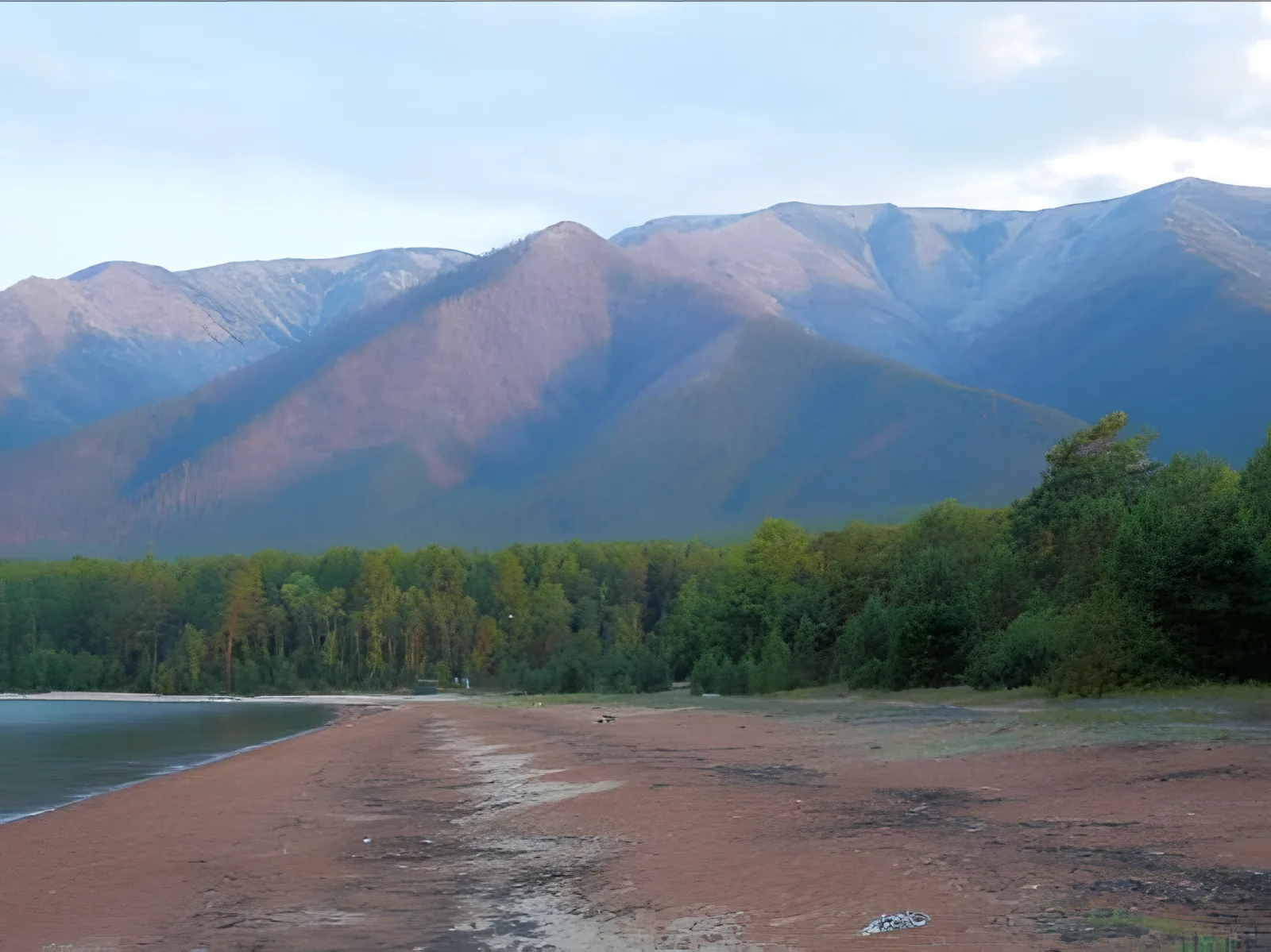
Yes, sometimes I even feel like justifying myself, looking at the faces of the stern men listening. Yes, I am like this, well, sorry – a “blonde”, sorry that I’m not a mountaineer and not an athlete, sorry that I’m not from a national team or some alpine club. And justifying myself: but, you see, I need to go there, and since that is so – I become the initiator of an expedition. And all this, naturally, I don’t tell them; I go on technically describing the specifics of mountain routes. I tell of various incidents on the way, give away the secrets of winter climbs passed on to me by my guides and teachers – seasoned mountaineers. I go on revealing to our guests the technical tricks and subtleties of survival on glaciers, sharing my delight at how little trifles can literally decide everything. I am touched by how the men listening to me sometimes lose control of their faces while we discuss the technical side of the matter with enthusiasm. Or, on the contrary, I gladly become the pupil myself and ask questions in my turn about how it can be otherwise.
I gladly give away the secrets and subtleties of the summits of life that once delighted me – let them know – these little nuances save lives there, at icy altitude. For a good number of points in this lecture someone once paid with their life. For example: it is useful for a beginner to know that on the glaciers, mountaineering boots and the gas canister must be taken into the sleeping bag with you. There are other “oddities” of people’s behaviour in conditions of extreme cold, such as warming the gas canister from outside with a turbo lighter while water is heating on it to boiling. And other “wonderful” tricks and peculiarities of daily life…
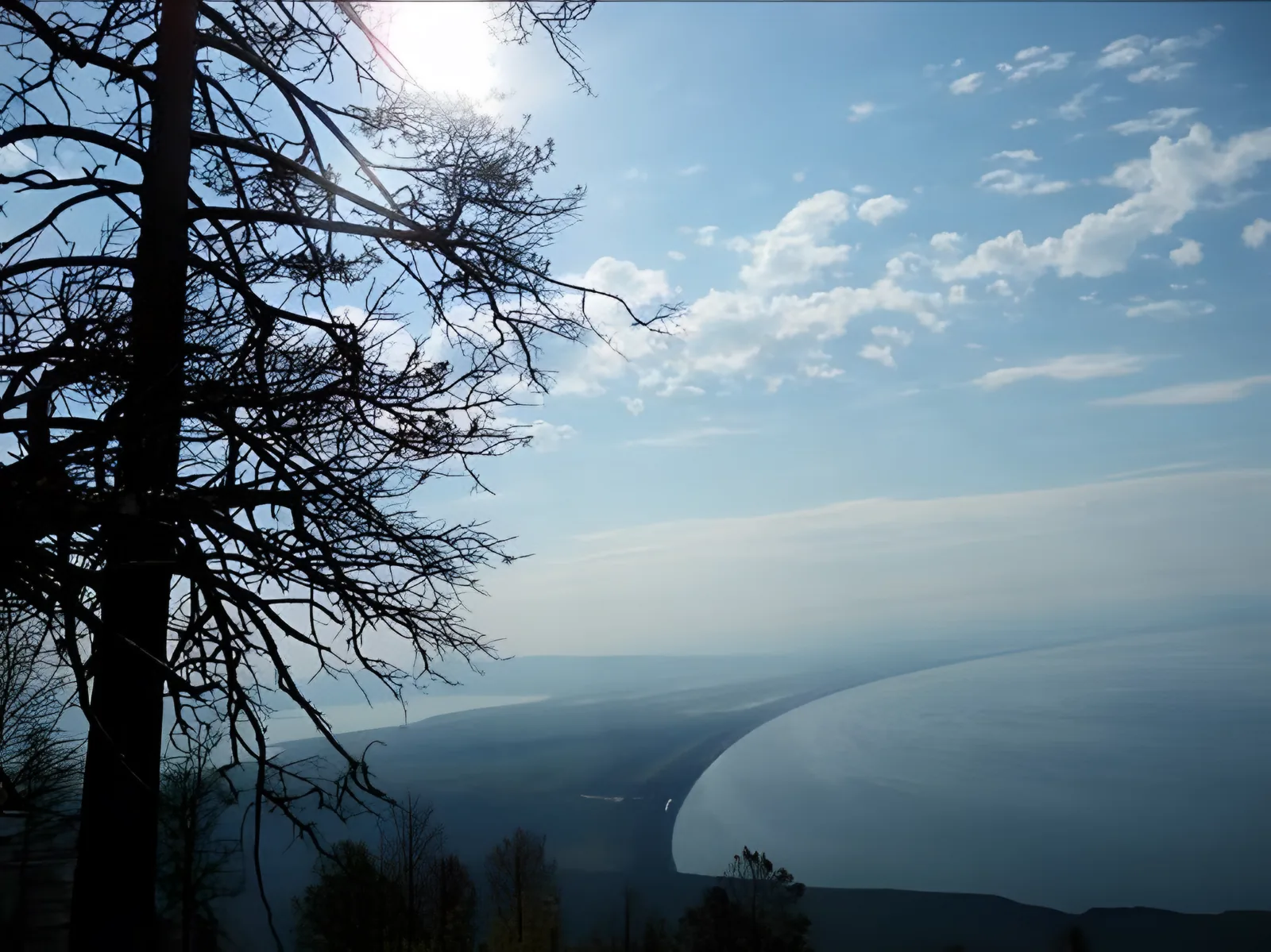
Having spoken seriously about the important, I again describe with tenderness the contrasting states of people that change in the course of a climb. From “please, let me die here”, through delight at the grandeur of “unprecedented beauty”, right up to summit Zen-silence. There roles, games, sex, age, the past, emotions altogether disappear, and only presence remains – an inhalation and an exhalation, a step like a metronome and a pulse in the depths. All attention goes to the step and the breath, and there is nothing to think with, there is simply no energy in the body for it – a complete, deafening emptiness. Nothing is left of the person except movement.
The presence of movement in the complete absence of a personality. The system feeds what is most actual for it there, and this is not at all our Ego and not our thoughts. The most actual thing there is our living nature. Our capacity for Movement. Movement – existing since the beginning of time – whole to the point of impossibility – so total that it cannot be experienced down below. Because the multitude of possible paths and roads on the plain distracts attention. And in the situation of a climb, when orienting towards height, distracting choices vanish and one direction is clearly drawn – orientation along the gradient.
One thing matters – the living movement of life within one’s living essence, beyond one’s own reasoning personality torn apart by contradictions amid a multitude of possibilities. Movement from the Unfree Personality, torn by the many existing directions, upward to the Free Essence that feels its path. This is another freedom; it exists on the other side of possibilities. It is the freedom not to choose, but to follow one’s single chosen choice without being distracted by doubts about the advantages of other roads. It is the liberating knowledge that the best is not always the suitable. Knowledge that frees you from the need to compare constantly and to doubt. Knowledge out of feeling yourself and your direction, knowledge that is free of fear of error. With which the consciousness of the modern dweller of a megacity is soaked through, as firewood is soaked with moisture in a Carpathian forest. And until all the moisture has evaporated, this firewood, like the people of the city, cannot catch fire and transform down to the primary element, radiating light and warmth.
For this inner burning, for this alchemy of transformation, people climb so high.
To lose all contact with one’s ephemeral “knowledge” about oneself, so that all one’s own opinions about “what I can do”, against the background of transcendent experience, become obviously outdated. To explode, in order afterwards to find oneself whole again, at a new level of knowledge of one’s might.
And let me share my secret reason too, about “why I need to go there”. To where it is more than 5,000 metres above sea level (of ordinary consciousness), only those special people reach, in whose blood there is red-hot plasma. Such people can’t be recognised on the plain; you could search for a long time and not find them. These are “border people”; they choose to be on the edge of the possible. And of course they cannot resist the temptation to go a little beyond… It is exactly these people who drive evolution; they are so dear to me that I very selfishly want there to be more of them.
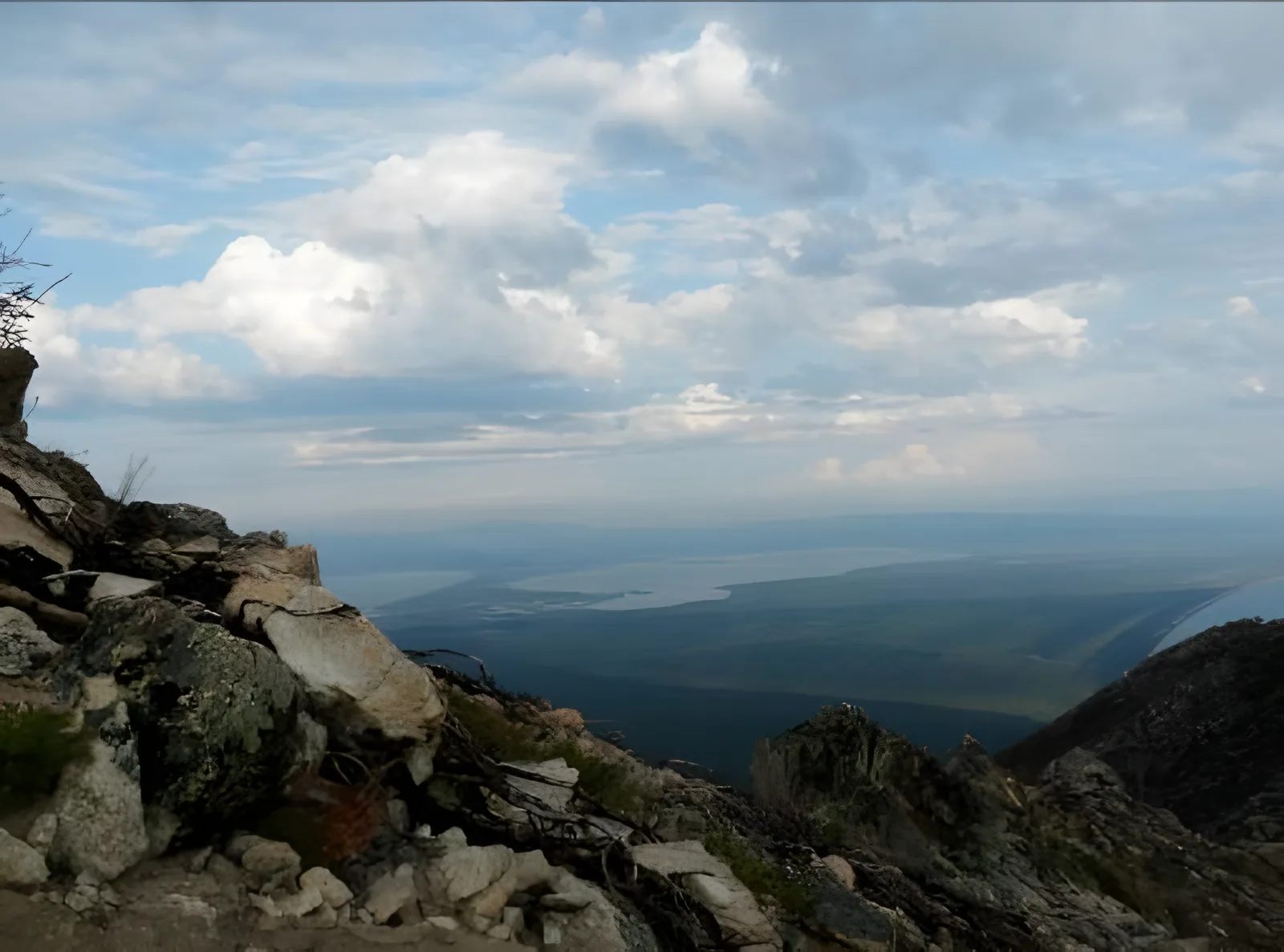
Telling about mountains switches me on. I want to inspire those sincerely curious about this subject to action, and in essence, by sharing, I am manifesting: “since you listen to me with such interest – it means you want it yourselves, and the main thing is, you can live it yourselves! If one person can do something, guess what I’m hinting at? It means that what one person can do, another can repeat. It is possible! That is how a living person once inspired me four years ago. So the idea of the impossibility of the possible receded in me, and now I am carried around the world still – and now Baikal…”
Before I decide to lead an expedition, an almost animal feeling of magnetism to this point of the planet visits me, and suddenly it turns out that not only I need to go there. People are drawn, drawn to the idea of going to these places. And those who know how to get there are drawn too… Sometimes it seems to me that my life flows from the future into the present. And my job is simply not to obstruct, with my fears, the birth of what in the future already exists as a given, as a point of an event on the track of life.
Oleg – the older of the men, he was about thirty – after a long pause, looking inward, shared his long-held dream of Elbrus. You could see how cautiously, from the back streets of youthful hopes, the excitement of the prospect of big roads was flaring up again, and at that moment I even saw that he would have the summit of Elbrus, and, touched, I kept silent about it.
And then came the place for a “feat” on the part of our guests, and they suggested sailing to the hot spring right now. …Yes, that’s a wonderful idea!
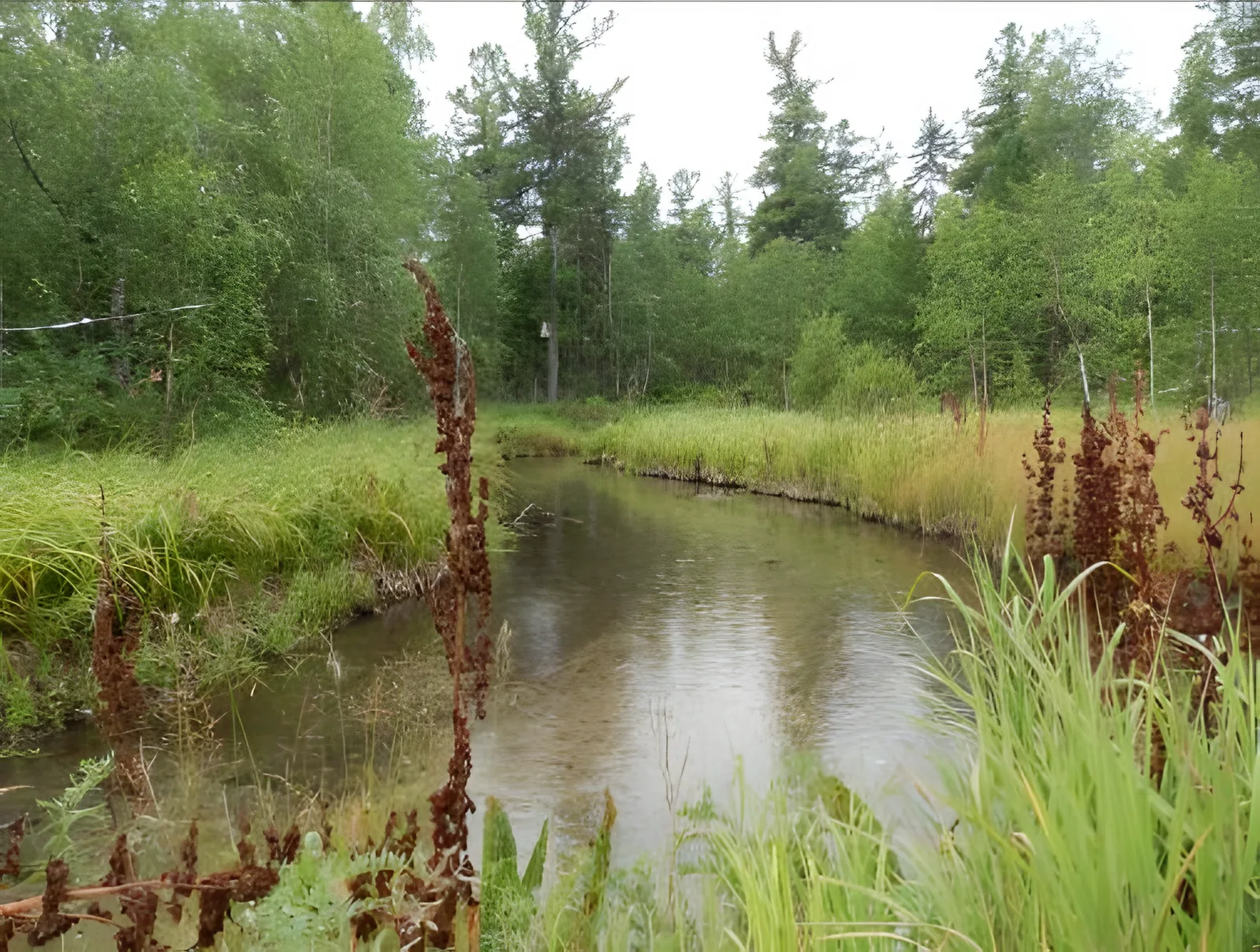
I love swimming naked. I always prefer to swim like that in wild natural waters – mountain rivers, waterfalls and lakes. You might say that I openly propagate it by my very state. Even in the Indian or Nepalese Himalayas or even the Arab Emirates, where it is in principle not characteristic of the local population – I and others like me, lovers of the “wild and real”, find a way to enjoy nature without frightening the locals.
This night was exactly such a wonderful opportunity. In the daytime, when we sail there, there will be tourists fully equipped with swimsuits, and after dissolving in these wild places I so don’t want to remember abruptly the strange traditions of etiquette in public places and the smells of civilisation.
These lads, after mutual stories “about life”, about the intimate, about fires and expeditions – after “everything that has been between us” – had become for us just like old friends or classmates. Flirting and other “mating games” typical of people at this time of day would now be entirely out of place. For we talked like real guys, and I watched horizontal lower thoughts give way to vertical summit plans. Respect came to replace temptation. Yes, mutual respect for the unplanned discoveries about people and their roads now overrides all the stereotypical gender games that men and women usually play in a similar night-time situation.
An alternative to the traditional folk “mating games” leading to Arousal can be “games” leading to Inspiration.
These can be conversations about the beyond. About extreme situations, about threshold states, about when death is near and when life is very bright. About new possibilities that go beyond the previously known. This is what kills the old ideas about the world and the possibilities in it, and widens horizons. For it is precisely so, “crossing fields” – looking at another living person nearby – that we receive Initiation: we are inspired to open in ourselves that “I can” which, reading about such things, we could only dream of. And this alluring and frightening yet so obvious new thing, brought by a living bearer of experience, ignites in us not so much the body as the spirit, and we are – Inspired.
Chapter 5. Fear and Passion – bridges of development
Passion and fear fill the body with vibrations in a very similar way. And although for the mind these are very different things, for the body they are almost one and the same. Alpha and Omega – sex and death. Just as to an outside observer uncontrollable laughter and desperate sobbing look practically the same. So here, considering trials for the mind is certainly no less tasty than considering with the mind the temptations for the body.
The idea of sailing off into the night with barely known men appealed to me and to Shamaness. But she said at once that she wouldn’t swim, and I did not ask her why. Later she would say that she couldn’t let her friend go alone on this “adventure”, and the idea of a ride with the wind in the night on Baikal also attracted her quite a lot.
We turned our faces from the fire and were struck dumb by the sight of the lake. It was smoking, as burning grass would smoke. It was a low creeping mist over the water, lit by the full moon. It stirred like a white veil, under which the water’s surface glinted. The mist rose into silhouettes, and they tried to come ashore to our fire – it looked like the set of some “Lord of the Rings”. And it was obvious in this performance that “no one has yet surpassed the Creator”. Whatever man invents – it is all acts of plagiarism…
The motorboat cut through the low mist, driving a glowing wave under its veil, and we, wrapped in a blanket, without phones, money or documents, with a deep feeling of the rightness of what was happening, sailed off into the night. Holograms of taiga hills floated past us; the landscape, lit by the cold bluish light of the moon, turned.
The water in the pools was very hot, so hot that you could enter it only slowly and with frequent holotropic breathing. The pulse quickened and seemed to stir the hair on the head. The breathing was interspersed with exclamations, and you might have thought it wasn’t the water but the people who were affecting one another this way. This sound background added to the pleasure of the bathing and lifted everyone’s mood, not just the temperature. I liked being here in the company of wonderfully built men, and once again, as happens in the mountains, I find myself the only woman among the best men for many miles. And at the same time I am nobody to them – and I especially like that, because I can admire how moonlight is reflected on beautiful bodies and there is no need to move it anywhere, and no need to bring anyone closer or, conversely, defending myself, to push away; it is not about anything sexual or social-role. It is beauty – freedom and pleasure in pure form, which needn’t be improved, realised at once, or necessarily used or appropriated in some other way. It is about sufficiency and the abundant fullness of sensation from oneself, the space, and others in it. And above all, it is about respect between all three elements of the action.
Here there appears something that has been well forgotten in people’s social games: sacredness. By sacredness I mean the Purity that those who feel it do not want to violate with a careless “movement” stereotypical for the situation. Because these moments are lived as mysticism or magic – self-sufficient in their aesthetic beauty.
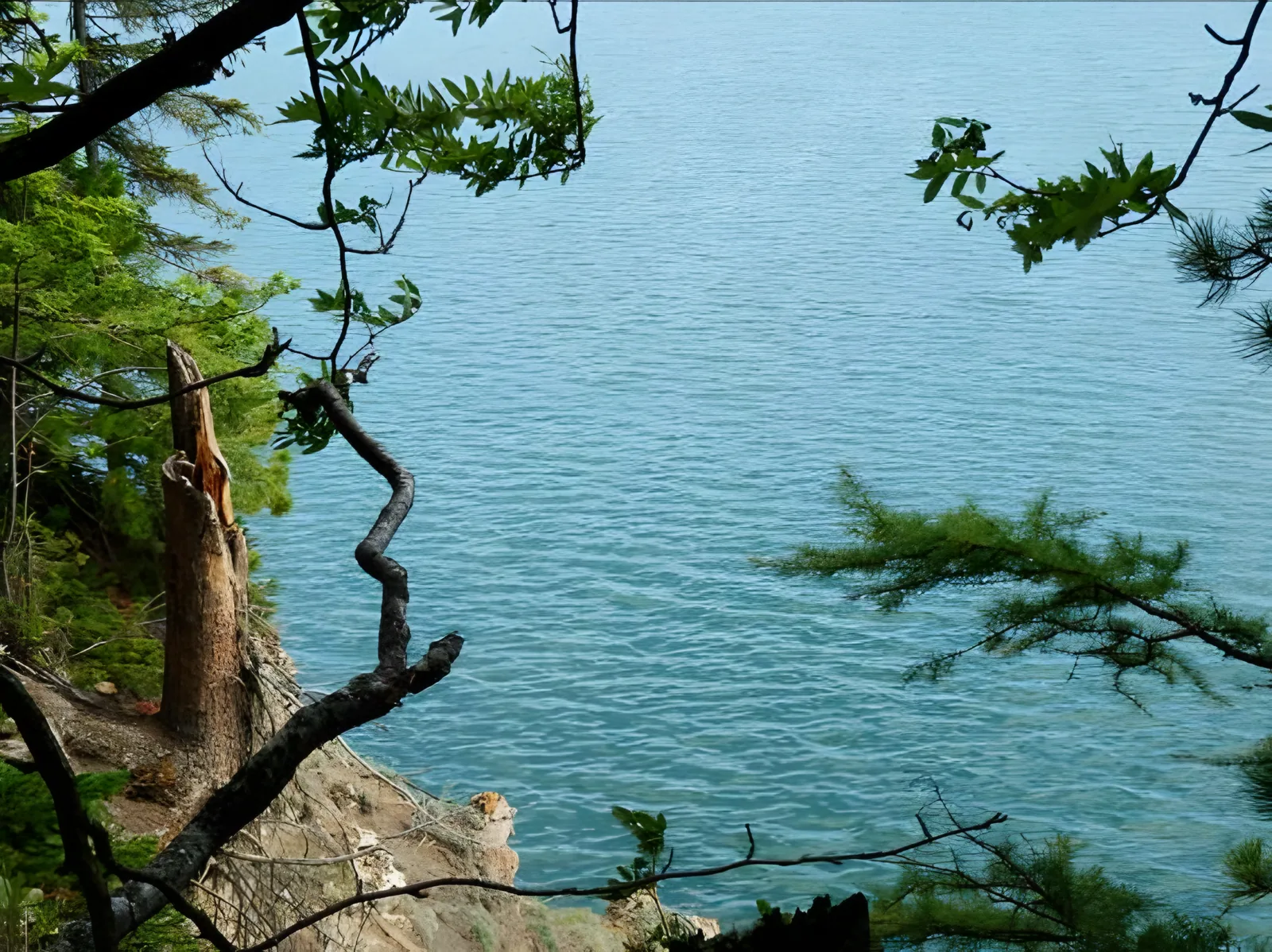
Afterwards, on our return, Shamaness told me that the older man went up to the boat in which she sat waiting for us and said to her on the quiet: “You’re making a mistake… You will never rest the way your friend does.”
“He worried for her “fine, – I thought, – there you go, how caring and warm…” Such reliability, safety and a wish to bring good were shown in this one gesture of his. He, like most healthy men in this world, did not want to be feared…
We sailed back. Now, after the body of the spring, the cold coming from the lake was felt especially sharply. On the shore by the fire the talk started up again and we discussed the point of our acquaintance. Oleg said: “You Ukrainians can be strange people when it comes to the law. Once I asked one of yours for his documents, and he said to me: ‘Do you ask a squirrel for documents? Well, I’m the same!’”
I tell him with a smile: “That’s creativity. In relation to Russia we are southern people, and the more southern a people, the more emotional freedom, looseness and spontaneity there is.”
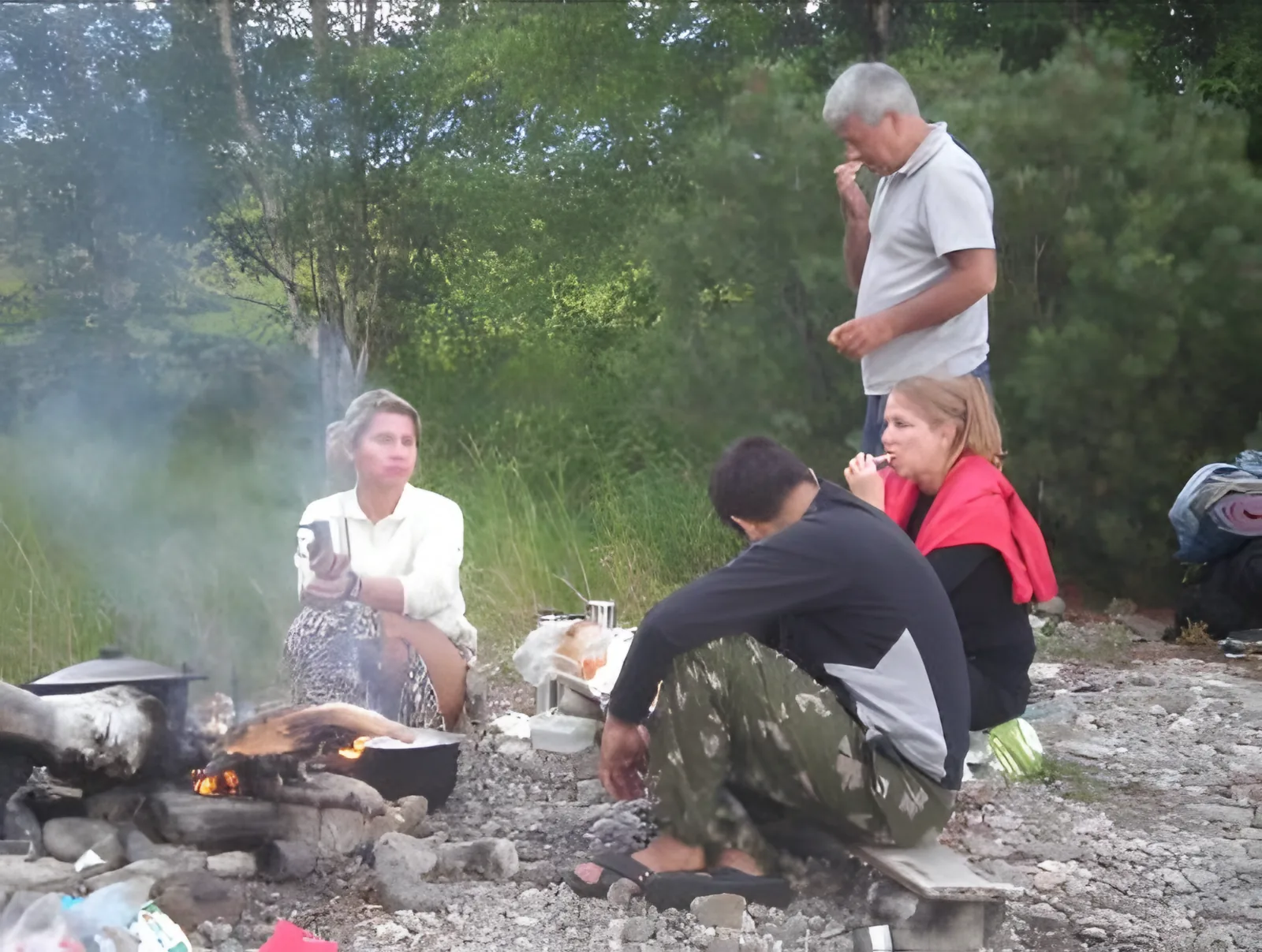
As we said goodbye, Oleg, from whom I had the feeling of a “very much a man”, a man of few words, suddenly began to speak. Every word of his, and the pauses between them, was palpably weighty. Unhurried, without formal politeness, “from the living”, out of his inner truth, clothing meanings in words, he said: “Thank you, and especially your leader” – here he stopped, and in that pause you could read his own new decisions about his future, and he added: “Very unexpected… thank you!” And I, watching how fresh thoughts about his possibilities lit up on his face, stood up and held out my hand for him to shake.
…Somehow, ah! I badly wanted to look ahead and find out what would be realised for him in a couple of years, such a weighty pause it was, and such strong language from a silent, contemplative man with the energy of a born leader. Something had obviously called him, and more clearly than what had been calling him for a long time. It called him so that it will not leave him in peace until he merges with this realisation of his dream.
As they sailed off into the night mist, filled with new meanings, it seemed to me that just for the sake of telling these young men about big mountains on this night, in such strange circumstances, it had been worth flying to Baikal. They certainly got here not what they expected – and that is good. What can a person expect to get? Only a repetition of past experience, their own or someone else’s, and can even pleasant past experience compare with the novelty of the unexplored?
Past experience, by the very fact of its existence, through comparisons and projections in memory, will get in the way of living new, living moments. But when the present carries us away so strongly that it eclipses all analogies with the past, and we seem to lose ourselves, in fact at that moment we are not losing but finding. What we lose is our controlling and rationalising mind, and we find the Living Self, warm, mobile, the one who exists in us somewhere below the neck. And the head in this action, with its “brain with nowhere to put it!”, finally begins to take its proper place as the 5th limb – whose function, like that of the other limbs, is to deliver its owner to the place where he realises his nature.
A morning of wondrous beauty, the dawn mist over the river, now altogether new, lit by the pinkish shimmerings of sunrise, reminded us that the fairy tale goes on. Shamaness, waking up, saw right beside her (and we slept on karrimats by the fire) a bear’s track. The track was clearly imprinted, with pads and claws, at the very edge of the water, and while she went for her camera, the track was washed away by a wave.
Having gathered berries to our heart’s content, we broke camp and paddled out of the bay. Now we could slowly study the pattern of the shores, the sandy bluffs and the suede-like hills lit by the afternoon sun. They had already become our own in this space. As people become our own whom we have got to know emotionally in depth – having managed to see them in grief and joy, having become closely acquainted with their light and shadow sides.
Chapter 6. From the wild places to people
For several hours we sailed to the hot springs – paddles, not a motor, and that is beautiful in a different way. The civilised bathing took place. Now the place looked quite different, the magic had vanished – there were tourists, a queue to the springs in trunks and swimsuits. People were brought here on motorboats or yachts from the opposite, civilised side – not for experiences but, by the “official” version, for health, so the bodies and the state of the people were different from our bodies of the night here. Now I admired the mountains more while my group enjoyed dipping into the sulphur hot pools of different temperatures.
Before sunset we managed to cross one more bay, a big one for our catamaran, and already at dusk (and it is long here) we finished hauling the catamaran ashore, marvelling at how cold the water in Baikal still is. In this part of our journey we merged with the civilised places of rest for “wild” tourists. Here, along this shore, special tidy camping spots were set up every 200 metres: a table and a place for a fire. Otherwise it was clean and wild. Somewhere out there in the distance a bungalow could be seen, and the guide said:
– There’s omul there! Today we’re having fish for supper. We’ll make a fire, mashed potato, and what else do we have left in the way of vegetables?
Omul is a Baikal endemic that is found nowhere else in the world. But there is a great deal of it in Baikal. It is caught with a net – smoked, salted, fried. It looks like… a fish. Moderately delicate, the size of a palm or bigger, a fish that is neither mackerel nor herring but along those lines. The purest water of Baikal makes its meat somehow “rightly” wholesome, but this can be felt only by tasting it. In the same way we can feel, for example, the difference between waters from different sources, but it is impossible to convey it in words.
The evening was tasty, truly, literally tasty; before that our taste had for many days been filled by Baikal’s beauty and our own new sensations. For many days we hadn’t noticed any discomfort from being unable to replenish our collection of food supplies – buckwheat, potatoes, cabbage – and here was fish and fresh bread! It felt like a gastronomic orgasm. And even the fact that the potatoes turned out with sand could not spoil the festive supper.
There turned out to be sand in the pot because Dancing Thunder had filled it in stormy Baikal and in complete darkness.
With Gorgeous Woman we argued about permissible and impermissible methods in psychological practice. I liked her very much, and with those I like I especially love to argue and “tug them by the whiskers”. I believe in them in advance – they will hold up with dignity and, in the process, tell about themselves more than they had planned. Well, that’s interesting, you must agree!
In the morning we did yoga on the shore. Gorgeous Woman did her yoga a little way off. The guide was conjuring up food for everyone. During breakfast he talked so willingly about the treasures that can be found right under your feet that we decided almost at once to set off for them immediately. A few kilometres along the shore and through the forest, and we would come to the camp of a wild man. It is a shore where the waves wash out jade arrowheads from the primitive tools of wild man. Jade is a very special and valuable stone; it has a property unique for a stone: a blow to it leaves a dent, which makes it unlike any other mineral.
Taking off our shoes and wading into the cold water, sorting through green pebbles, we asked Giver of Meaning what jade actually looks like, and soon it became clear that finding a trophy would not be easy. And we switched with excitement to collecting other kinds of gemstone beauty. I watched how this emotion gripped me. Even greed, a feeling so rare for me that I gave myself up to it with tenderness and delight. Stones are my great and, one can say for certain, my oldest weakness. Already in childhood I collected them in various sand dunes, steppes and beaches and carefully put them in a “Vechirniy Kyiv” sweets box. And at a time when normal children collected calendars, stamps and bubble-gum wrappers, I collected stones from under my feet.
At the entrance to my Kyiv studio, on the wall a full-height tree grows, made of stones from different corners of the world. Finishing the renovation before the studio’s opening, I asked my builder to show me how to mix cement, and the trophies that had lain around for so long finally found an altar place on the wall. A few kilograms of Crimea, the Elbrus region, the Carpathians have settled on this tree, several stones from the bottom of the sources of the Ganges, “rubble” from Mount Ararat, lava from the crater of Kilimanjaro that looks like chocolate with nuts, stones from the eastern summit of Elbrus, fragments of rock creeping along the Khumbu Glacier near Everest, stones from the beaches of Zanzibar and the Caribbean islands and from other places on my path.
It is not just a map of journeys, it is a tree, a keeper of power, like a shaman’s robe, where every element is a story… About trials, about discoveries on the way and about pleasures. And it is so amazing that any story about trials ends in enjoyment – victory and celebration of the end of the trial. And any enjoyment ends in a trial. And that is – to survive the end of the enjoyment. Or the trial will perhaps be not to fall into temptation, getting stuck on pleasures. Not to get stuck but to go on – what is that if not a trial for the Spirit? It is amazing, but if you bring to the maximum of its manifestation any of these notions, be it Trial or be it Enjoyment, it will turn into its polarity. That is exactly why in this world there are no universal ideas about how one ought to live correctly, or unambiguous answers about where a person should look for happiness. And if we think globally, there is no need to look for it; it is in everything.
Just like Power – it is in all living events in which we are wholly present. It is in defeats and achievements, in joy and pain, and in sorrow it is there too. I sometimes begin to suspect that it is unambiguously in movement. But if a person brings even movement as a lifestyle to absurdity, he may find himself absolutely stopped inside, running in circles in the bustle of automatism. Running away from the theme that stands unresolved. Then for him Power will be a conscious stop. He stops outside and discovers that he has finally begun to move inside and to feel life again.
It turns out that Power really is in everything! And when it suddenly ceases to be felt, it means that the time has come to move into the polarity of what the person has been occupied with lately in life. The shamanic formula of Power is to move into the polarity in time.
The guide found jade and, seeing my interest in the subject, gave it to me at once. Soon I too found a miniature jade scraper, olive and speckled, with traces of primitive creativity. We found no more jade.
Rainbow, Dancing Thunder and Gorgeous Woman went with the guide to camp to prepare lunch. They went with trophies, filled with the simple happiness of gatherers. Shamaness and I, magnetised by the beauty, stayed on the shore. The taiga forest, in the rays of the midday sun, hung almost right over the lake, leaving only a metre and a half for the shoreline of sparkling gemstones.
And then, quite unexpectedly, a private pleasure yacht began to turn in towards us. A cheerful company spilled out to the right for a stroll, and the yacht’s captain, a young fellow, came to us, to the left. He introduced himself and began telling us that he does trips around Baikal, and, here, get in touch, he has a boat and would be glad…
– And by the way, wouldn’t you like some fish soup? We’ve only just had lunch, we have some left…
“We would,” said Shamaness. And he carried out a saucepan and the freshest bread to us on the shore. It was both very timely and unexpectedly tasty, pleasant at the same time. He left his contact details in case we should ever want to visit Baikal again, so, welcome. His boat’s guests climbed back aboard, his helpers washed the dishes, and they cast off as swiftly as they had sailed here from around the bend of the spit.
Chapter 7. The Amulet – an object of Power
Returning to camp we began to look over our trophies, and I decided that the time had come to make amulets. We settled on the shore and covered a large area with karrimats. (Karrimats are light mats that tourists and mountaineers use on hikes as a little mattress in tents.) We laid out in the centre the materials – leather scraps and threads brought specially with us. We eagerly set about creating our own Objects of Power. We wove around stones, combined colours and shapes, building a whole out of parts. A whole in which every element is endowed with meaning and is bound up with personal discoveries and current inner directions.
I rejoiced like a child when, besides jade, I also got to find a druse of white crystals lightly touched by the waves of Baikal. White, translucent hexagons in the company of “their own” combined at once two incompatible aspects – the soft smoothness of sharp angles that keep the power of water, and yet a good “legibility” of all their tips and mathematically perfect sides. For the other participants their own trophies aroused similarly tender emotions.
Making amulets is a “magical” act or “folk art in the spirit of primitivism”, whichever you like to call this process. In fact this process has an incredible therapeutic effect, which shows itself in the course of creating your own Object of Power. In this action two of the most important foundations of the personality of a mentally healthy Human Being are joined.
The first aspect is the Inner Child who lives in us. Childhood is that golden time when the world seems to us absolutely magical, and this means that everything you could ever wish for is possible in it! The process of making something is experienced by a child as the most important ritual part of the creative process, and the objects from which we, as children, fashion something are alive and carry on a dialogue with us as with their creator.
The second aspect is our Adult part. The one that structures our real world. It is the Operational Part of our mind, where there are no emotions but only tasks set for oneself. It is the most adequate part in a person; it is precisely thanks to it that in this world things are brought to completion, projects are created and realised, and objects of the material world are born.
In people in depression or with other neurotic disorders these two most important parts of the personality are clogged with layers of personal drama. Their Inner Child does not play, because it is wounded, offended, immobilised, too serious and withdrawn. Meanwhile the Inner Adult throws a fit in an inner emotional seizure, falling by turns into apathy, bitterness, anger, blaming the world, or simply, in a don’t-give-a-damn way, sabotages the goals it has set itself.
By doing new or long-forgotten practices, a Human Being really does cleanse their own nature (the “palette of paints” with which they paint their world). Their Inner Child becomes playful and magical, and their Inner Adult responsible and practical.
Once, in my studio, at Max Skoblinsky’s classes, I was painting an oil picture with my fingers on canvas and, not understanding some technical points, asked:
– Max, why is it that when you come up to my canvas and make strokes, they are so clean? Max, how do you get clean colours?
– I simply have a rag, and I wipe my fingers before I take another colour.
– Ha, how simple!
And many people also have a “rag” in one hand, and they don’t use it! “Strange, but people forget to use it,” I thought, as an incorrigible psychologist, transferring this metaphor to the lives of some people. When I know where in my palette the red, the white and the black lie… I will get a result on my canvas of life. The one I really paint!
It is hard to paint something three-dimensional with chaotically mixed paints – it comes out dirty and flat. It is good to return to pure colours, if of course you are the Author. It is good to understand which mixing of paints we need right now for the desired effect, depth and volume. If you are not the Author, then it is good to know which paint you are. Perhaps you are now on someone else’s canvas – and here too you can enjoy the process – when someone, or reality itself, smears you around. For, showing yourself on someone else’s big “picture of life”, you are paint, and that is ALSO a feeling of your own being. A human being has one of the basic human needs – to Manage and Influence. Knowing which paint you are, you already influence the course of events and fulfil yourself in it.
The needs for sex, food, warmth, for reproducing offspring and caring for them are not yet human but animal. And even the need for Freedom, which so many strive for, is not a human need. Freedom is a normal animal need for Liberty. The tragedy of the human being is that he cannot move on to living the human in himself until he has “closed” the fulfilment of his basic animal needs. So “animal” in this text is not an opposition to the human – it is the obligatory foundation of humanity in the human being, the basis and condition of his initiating creativity. Creative authorship in a person is realised through his conscious ability to Influence the world.
It begins with awareness of oneself proceeding from a state of Abundance, when all his basic animal needs are precisely met. If they are not met, a person feels not himself but his hunger and fear, and then he spends the potential laid down by nature – Creativity – on his survival. You can see the aesthetics of a dance in the agony of the dying, but that is a quite different, surreal act in which the dancer did not “plan” it to be so… He suffers, he doesn’t know who he is, he is looking for himself, discovering his “paint”. If so, then as the Author of his life he does not yet exist. The Author has not yet been born in him.
Just imagine: a person is searching for himself. He is as yet “drab grey-brown-crimson”, “neither mouse nor frog”, and not an Author – that is sad. It is unbearable for a person to feel like nobody. By and large, it is even impossible for a person – to feel absolutely like nobody. In the depth of his truth about himself, from the self-sensing of his needs, he knows that he is. And in this critical assessment of himself as some powerless “nonentity” (an inability to fulfil his desires) the person feels that a great lie is hidden, a lie to himself about his essence, contact with which he has lost (or not found, or mislaid – underline as appropriate). And he searches.
The presence of animal needs just helps him in this search – to feel alive! Alive through the rational needs of the body.
Creating Objects of Power is a special irrational occupation.
There are servant objects – household appliances, shoes, furniture and so on – they are rational. And there are objects that are allies, objects that are friends and teachers. They do not carry any obligatory function. Their task is not domestic, and by and large they are useless in daily life. Their tasks are not from the manifested world. They are a bridge between the manifested and the unmanifested. To have such objects is a luxury, not a necessity. The need to have non-functional objects has always been the prerogative of the elite and of priests. What is there in their worlds is, from the point of view of the ordinary person, simply a whim, a fancy. But the ordinary person creates nothing beyond his little family. He is not an author in the big world – he is paint. And so he, the simple ordinary person, sincerely doesn’t understand the motives, deeds and inalienable “whims” of those whose life goes beyond the little family…
Chapter 8. Walks in four directions.
On this endlessly long day we managed a lot more. Rainbow and Gorgeous Woman went once more to the hot springs, this time on foot along the shore path, and on the way back “seduced” a boatman into bringing them to camp. I went into the forest for “game” – for the bear. But “instead of him” that day there were black squirrels and chipmunks. Magnificent squirrels – black fluffy fur and a white shirt-front on the chest.
– Just like bears, I thought – only squirrels.
Lively, nimble, playful squirrels and striped chipmunks didn’t run away; they flirted, called me up to the tops of the cedars. What a metaphor for my life, I thought:
– Here again, “hamsters” – chipmunks, squirrels… One big, significant, weighty “bear” could be here – in the place of the many small projects of mine. That is how I too sometimes tear myself into many little hamsters – little jobs – instead of giving myself wholly to one big project.
But the little animals delighted me with their liveliness and sociability. The forest is alive, fragrant – full of berries… and I also found a spring in it.
When we were folding up camp again in the evening, pulling out the tent pegs I was surprised at how cold the ground is here! The aluminium came out of the ground unrealistically icy. So all this blooming, summery, flower-and-berry beauty nests only on the soft forest litter, and right there, at a depth of just 15 centimetres, is earth that in the short taiga summer doesn’t even manage to warm up. Only cedars and birches are not afraid of this cold; other broadleaf trees are rarely found here for exactly this reason. We deflated the catamaran – the vessel on which we had moved over the water together with all our camping gear now fitted into a narrow, long 2-metre bag.
In the evening the boat “Volny” (“Free”) came for us, and in the rays of sunset we cast off from these places. This boat was owned by an interesting, colourful couple – he, an “old seasoned sailor”, calm and reliable, and she, “Sonya the fisherwoman”, a red-haired, cheerful, hospitable plump little dumpling.
Where we embarked there was no jetty, and a ladder was let down for us right into the water. So we had to strip to our pants to load our things. The water was bracing, and once aboard we gladly ate supper of fresh bread and fish, warmed up with tea and went out on deck to see off the sun. The sunset is just as endlessly long in these places as the sunrise.
On the boat’s deck, unexpectedly, there stood a classic old sofa with a view of the stern. Lovely. Rainbow, Gorgeous Woman and Shamaness settled cosily on it. Above them was the narrow window of the wheelhouse, and higher still, above the window, the inscription of the vessel’s name, “Volny”. When I pointed the lens at them, I badly wanted to add the note “do” to the vessel’s name.
We arrived at the port from which our voyage through the protected places had begun already in deep blue-grey twilight. And having unloaded, we immediately felt the difference between the wild shore and the port.
We sent a messenger, Giver of Meaning, to scout – to look for a place to spend the night. But the grass and the forest here were so greasy – petrol-smoked and trampled – that we decided to go out onto the road and settle somewhere by the roadside – to spend the night under the open sky so as not to pitch tents, and in the morning be ready to move on at once. All the more so as, according to the plan, we were to hitchhike to the place from which we climb to the mountain plateau of Svyatoy Nos, and it was still some 40 km to the foot of that mountain.
For the night we chose a place where the smells of the port didn’t reach – it was a turning place on the road. In several trips we carried over our things and began settling down to sleep. We laid the karrimats closer together to keep warm in the night, and when we switched off the torches, the taiga night sky hung over us, deafeningly shrieking with sparkle.
The moon had not yet risen, and the stars, weighty as kilogram ingots, edged with misty scatterings of smaller jewels of light, drew the Milky Way so low over us that you could touch them with your hand, without even getting up from the grass. The mosquitoes had already switched off; they switched on here at sunset and sunrise, for just a couple or three hours. And now you could admire such a bright sky for half the night, until the rising of the beauty – Old Mother Moon.
In the morning Shamaness and I woke earlier than the others and, with a morning delegation of fresh mosquitoes, set off to the port to replenish our food supplies. Giver of Meaning began preparing on the gas burner his signature morning drink – cocoa with condensed milk. In such roadside conditions it is unbelievably tasty. Although for the most part on the trek we drank tea from the leaves of berry bushes and a grass called here “badan” – overwintered, brown, fermented leaves, like Chinese pu-erh, with the taste of earth. But cocoa is quite another deliciousness; sometimes just such social interludes let you miss by turns now the wildness, now the comforts of civilisation. They give you the chance to appreciate the already familiar with a fresh eye and to enjoy the different, to value what comes, finding something new in everything that happens.
With the morning cocoa we brought “Kyivski” rusks with raisins. To buy Kyiv rusks in the port, 6,000 km from native Kyiv, seemed surreal.
Cups of hot cocoa steamed in our hands and we watched the chipmunks playing in the roadside thickets.
Surprisingly, we got there quickly by hitchhiking. In three groups in three cars. Hitchhiking is a special style of life – very Author-ish indeed! Hitchhiking is an art in which there is no place for artificial emotions. It is a very honest state. The more genuine it is, the more easily a person ends up where he chooses to be. Along the way, those who help him on the road also win.
First – (at the very least) the fellow traveller simply keeps the driver from falling asleep at the wheel. He wakes him with his novelty, like an envoy from unknown worlds.
Second – the situation of a direct request allows you, if you are the driver, to do a good deed on the way and to esteem yourself a little more for it. We humans like it when we know that the deed is definitely voluntary, and definitely on the way, and that no one will take offence if we refuse. We usually want to help – to “do good and bring benefit” to our neighbour; we are very glad to be useful. We respect ourselves in this, and here even a “thank you” addressed to us often seems superfluous.
Third – (at the very most) such meetings can “turn the life upside down” of a kind driver, and he, at last, will also begin to do in his own life what he had long dreamed of.
At a fork in the roads, where one goes to the port and the other to the foot of the mountain, we appointed a meeting point. About 200 metres away began a beach equipped with wild saunas. A wild sauna is a frame of young trees covered with polythene film, with a hearth laid out of stones inside, so that a steam room is created. We chose such a camping spot with a sauna in order to restore the body after the climb and to finish the journey around this Holy Lake fully renewed.
Having bathed, I remembered that this part of Baikal is deeper than those protected bays where we sailed on the catamaran – here the water was noticeably colder, and the depth didn’t let the waters in these places warm up much. Having set up camp, we started cooking borscht.
Shamaness would later say that she was simply apologising to the borscht, practically kneeling before it, for having “knocked it together out of what there was” – she cooked it from a canned dressing. Later, at the meal, Dancing Thunder would praise the borscht, saying: “Now that’s a real Ukrainian borscht!”, and say admonishingly to his Rainbow: “See how borscht should be made, so that you cook me the same!” Yes, the main ingredient in it was that it was cooked by a Ukrainian girl – see what ingredient may turn out to be the main Zen!
Over the evening tea in the circle we summed up our inner processes and gave shape to our discoveries. It was like thinking aloud about oneself and one’s life. The others, by their active listening, motivated us to put inner processes into words more clearly. And for the speaker his own role became clearer in the situations that had befallen him. In seeing these connections – between one’s own Role and the Events of one’s life – our human grasp of our authorship in life is born.
Chapter 9. The Ascent as an exploration of life strategies
The Trail of Trials.
In the morning, getting up at 6, we had breakfast, stocked up on dried fruit and water and set off on the climb. I shared with the folks my secrets of long ascents, those handed to me by my teachers and those I discovered myself on the way.
One of them – for me the main one – is the three-sided interest.
The first side is connected with interest in the place – the trail, the summit, the beauty from above.
The second, with the aim I set before climbing upward, and which I explore on the way, drawing analogies with my life and running into difficulties along the road. You can, you know, read coffee grounds – by the way, some of my girlfriends do it quite well – you can read Tarot cards, and you can read the track.
The third side is interest in your body on the way. In how it walks and how you can contrive on the road to let it rest and amuse itself on the way, with all the tenderness and gratitude to it that exists – otherwise it won’t do. Otherwise the body will take offence and won’t go on, will say: “I don’t believe you, master; you torment me and abuse me. That’s it, here is my summit! I’m going back, and you, if you like, go on alone, without me.”
That is why some don’t reach the top. And not at all because they lack strength.
That someone lacks strength is an excuse “from the mind”. If you can take a step, you can walk. The Path is always a repetition of one and the same step – take one step and repeat it again and again. It is natural. By the way, the human foot and legs are in general adapted most of all to walking uphill – it is the most natural movement for the body, as natural as breathing itself.
Yes, Breathing! Breathing – an inhalation of equal length for the number of steps and the same exhalation. Then the body goes into metronome mode, and here it is important not to hinder it with thoughts of your own – “I can, I can’t”. To be in it – in the body, to be present in what is happening here and now. To be more, in percentage terms, in sensations than in the world of thoughts. To trust your body more than the ideas in your head. To be strongly in your head is very dangerous. All, absolutely all injuries happen at the moment when a person has flown off in thought. He may have slipped his attention for a microsecond out of “here” by an unacceptably larger percentage than is permissible, and at that moment hit himself, stumble, run onto a branch or something worse. Pain will bring him back into the body. Very convincingly it will bring him back!
Even painful old age in people is an attempt by the body to bring the master, who is for ever “wandering” in his speculative worlds, back through pain. Into the presence of Living Life, to give him, at least before the “finish”, a last chance to be Present. The body always helps, remember that. When it walks – it helps, when it aches – it helps, when it wants something – it helps, it gives its master signals on the “dashboard of indicators” not to miss the moment “for replenishing the energy resource”. You must listen to the body – it is wise. The bodily – somatic – intelligence is wiser than the head, if only because it is far older than the brain. And it proved its wisdom when it formed you in your mother’s womb, thank God, without the slightest interference from your thoughts. The body restores itself after tiredness and after a breach of integrity – in injuries. And, notice, it does not consult your mind about it in any way.
It is the mind that would do well to consult its own body. And to treat it with respect and tender care, as the most important teacher in your life. As pupils treat a teacher in the Eastern traditions. Then, when it is so, your body will lead you where your mind never even dreamed, and you will get more than you expected. For you can only expect what you are familiar with from the past. That means living with your face turned to the past and your backside to the future. In fact, that is how most people live. They live without living – backside to the future, and the world, you know, is a mirror… it is to a person just as that person is to it…
Such was my speech before the climb. And I went on thinking this theme further while we walked across the plain. Sometimes sharing my conclusions aloud.
And instead of expectations it is better to meet the world in all its unpredictability face to face, looking attentively and with curiosity at what wants to meet us. And to solve questions and problems as they arrive. You may notice that most of the possible human fears never come true at all. Imagine: a person living in fears finances his inner “army”… and there are no resources left for real accomplishments, because he is always on guard and on the defensive, and an abyss of strength goes on that. Or, if he is in his thoughts in expectations and dreams, he “lends” attention to obviously ephemeral projects (expected dangers or unattainable dreams), and his attention leaks out of the present – now he lacks energy in the “here”.
He – LACKS. He chronically LACKS – and these are not facts of his life – it is the position of his mind. If the Mind is absent from the “now”, it is not “at home” – it is “now, not at home, call back later”, and this is the greatest lack. The one he confuses with objects and subjects of the outer world; this lack cannot be cured by any external factors – material goods, comfort, acquisitions, gifts, signs of other people’s attention to him.
All this, of course, pulls the “traveller through virtual worlds” into the present moment, into the short-term joy of presence in being. But when there is a breach “in the head”, then without the owner of the head being aware of it in himself, it is not closed from the outside. And even honest joy over external gifts will be fleeting and finite. A person gets used to everything external, and soon after all the “amazing facts” and “gifts of fate” he falls back into his basic emotional state, out of which his life proceeds. Some return again into sadness, some into anxiety (reasons are found), some into aggression, hunting for an enemy.
“What happens when nothing is happening?” – my teacher Sergey Strekalov’s favourite question. When he led a seminar, he did not come into the circle at once, and having come, he sat down and for a looong time uttered no words, and… not even looked, but let his gaze glide over the participants, then turned his gaze inward and again passed his attention over the participants. And for another 10–20 minutes, wearisome for the people, he did this again and again. In fact he really was “doing nothing” – he was living, just so, being in the circle, simply fully and weightily present in every moment.
At this moment most of the seminar’s participants, “just in case”, began to feel guilty. Another part – anxiety, some – indignation, and only a very few – delight or tenderness at all this wordless, spontaneous but very living, honest emotional-sensory process, readable in faces, gestures and postures, and especially in attempts to control one’s emotions with an imperturbable look.
Nearer the end of the silence, which he held without announcement, spontaneously, he might ask this question aloud: “What happens when nothing is happening?”, or not ask it and move on, as if nothing had happened, to verbally leading the seminar – to a lecture or a discussion. For example, “how was the morning?” or “who are you, and what is happening with you right now”.
So then, a person, when he is not in the “now”, has his attention in the past or in the future. He has very little energy; it is the consequence of unreasonable energy spending and of sponsoring with his attention topics that are not actual, topics absent from his life in the present moment. From such unreasonable spending he feels poor and deprived of attention at the point of space where he is present.
We can receive full-blooded, whole energy of life only from the present.
With the pathological strategy of the mind – not to be in the present moment – a person truly doesn’t understand why he lacks happiness in life, strength, energy, enthusiasm, courage and everything that can be gained in life by taking it out of oneself, simply by being and living at the point of “now”.
Those who can’t do this – be in the present moment (and they are the majority) – constantly dream that someone will love them. That is, that some other person who will love them would sponsor them with his energy, that is, think about them, while they spend all their units of attention on thinking about things that do not yet exist, or no longer exist. While they replay in their heads dialogues and events that will never happen in reality. While the dreamers or “expecters” go on busying themselves with all kinds of not-of-here nonsense and go on “arming themselves”, they don’t understand that they, the living ones, in real reality at the point here and now, simply ARE NOT. There is nobody to love. There is only that in them which one can sympathise with, and this sympathy they take for love, and afterwards they also take offence that the “act of mercy” ended unexpectedly. And one of them with resentment will quote Exupéry: “we are responsible for those we have tamed”.
How shall I put it? Both yes, and “not yes”.
All these formulas of happiness and unhappiness set out above flashed through my head as a short clip – I, naturally, did not deliver this whole tirade to the people before the climb, or else they would have left their bodies and settled firmly in their heads, trying to watch my “clip”. No need. Let everyone stay with their own “film”.
And the additional parting words were brief:
– …for those who’ve forgotten what the head is for, I’ll remind you once more: the head is needed to draw Conclusions and make Decisions; the rest of the time of life you need to switch on the body.
Someone prompts:
– And I also eat with it and also…
I interrupt, not letting her finish:
– That “and also” is precisely about the bodily. When you eat with it and “also something else” (the girl asks) that is body too! Yes, yes, it happens – the head is also a part of the body. But that is its second function.
Well, people sometimes feel that they have a headache. This pain often has no physical cause. There is, in principle, hardly anything there that could ache. The head is not an abdominal part. I mean that if you have a headache, find the topic that is not “about now” that you tend to turn over in your brains, and let it go, forgiving everyone involved in it. And above all – yourself, for something you are thinking about in this plot. And the pain will probably let go at once. You can experiment.
More parting words:
– Those who suspect they may rub their feet raw on the way can put on two pairs of thin socks. And at the slightest hint of rubbing we stop, take off our shoes and put on a plaster, without waiting for a sore to form in that spot. We take multi-layered clothing so that we can undress on the way and dress at the stops. How do we walk? Everyone chooses their own speed; no need to adjust to others. There is one trail up.
The guide explains the peculiarities of the trail and of this particular route:
– The track is called the Trail of Trials. It will often seem to you that the summit is just ahead, but beyond it there will be more terraces and more summits after that. And then, when you finally come out on the next summit and see a long, long ridge, it will be revealed to you that this was only half the way. The mountain is 1,800 m, and if you feel it is enough for you, you can return to camp and cook supper for everyone. It will count as a plus to your karma.. When you come back down – be careful! There is a risk of getting lost if at the fork in the wooded part of the mountain you go off along the right slope into another gorge. There is a swamp and a mountain river – there is no way to get round them to come out on the road. So you will have to climb back up and descend again, but further to the left..
He would give so much attention to this deviation along the wrong way. And would tell about it in such detail that our Gorgeous Woman would indeed repeat this “feat”. By the way – about Attention. It is all just like in life. Where attention goes – energy goes.
And our Gorgeous Woman – she is a very energetic woman!
Chapter 10. The Trail of Trials
We walk to the foot of the mountain along a well-trodden trail in thick forest. Before the ascent we are met by a poster – a sign showing the route of the climb. Yes, this trail has a name – the Trail of Trials. We see the route map. Further on the trail narrows to the width of one person, and we go in a chain. I gladly let the lads go ahead; it has long been unimportant to me which part of the group I walk in. But for beginners, I know for certain, walking is always easier in front. For the seasoned, responsibility for those walking behind gives strength and the wish to walk well.
The slope gets steeper, but we will still be walking through forest for a long while, 3–4 hours.
My physical preparation makes itself felt, and at some point I overtake them and lose sight of the group. On climbs I don’t need frequent stops – they rather hinder and knock me off my flow rhythm. Once, 5 years ago, I marvelled at how Vitya Olifirov walked on the trek to Everest – a seasoned mountaineer, a snow leopard, who was then teaching me to walk in the big mountains. He walked, it seemed, not fast, rather slowly, but like a tank. His speed didn’t change with the height of the mountain or with the angle of the incline and slope.
For beginners, there is first an excited dash, then obviously laboured breathing, which, like their speed, like their enthusiasm, depends strongly on the incline of the trail. On almost level stretches people burst into a run, and on the ascent they puff heavily and keep trying to sit down for an extra rest. It must be said that this ragged rhythm passes if you walk a lot. Contact with your personal flow develops – and then it is important not to hinder this flow from carrying you upward.
It is like in big categories – “first a person chooses the Path, and afterwards the Path chooses the person”.
Near the edge of the forest there stretched burnt areas, traces of the fire in putting out which the men we met in the reserve had taken part. The sight of these places was still very dramatic, though six weeks had already passed.
After the forest ended, the scree began – big stones over which it was not as convenient to walk as through the forest, but more interesting – you could feel like a hoofed, leaping animal – my boots were very right, and seasoned mountain people know how great it is, the right footwear on the way. So I am sure that normal people in ordinary footwear cannot get as much pleasure as I got from moving over stones under the scorching sun. Beauty, and at the rare stops – bog bilberries on low little bushes. In all, after 5 and a half hours, I was at the summit.
And there – tundra! Real tundra – reindeer moss, berries in clusters, little mushrooms among the bushes of bilberry, cowberry, bog bilberry, low dwarf cedar around the perimeter of this huge summit plain. The height here is 1,800 m, the plateau stretches into the distance for a good 5 kilometres, narrowing like a cone towards the horizon, and for that reason is called Svyatoy Nos (Holy Nose).
I went deep into the motley mosses. I lay on the ground and looked at the sky. And my inner attention watched the sensations, how the mass of lifted bodily material sparkled and shimmered, flowing downward under the action of gravity. All these “stars” of sensations fell down, passed through the skin and poured out in waterfalls into the earth – unhindered. The joints vibrated, the muscles rang with different voices, cells flung open, in the farthest corners of the body releasing “birds” into freedom, and I disappeared… Nothing was left of the “I”.
A physical pulsation of life, to which the “I” seemingly has no relation,
My personality did not create it – the Pulsation of Life. The Pulsation is, and I am not. It is from the beginning of beginnings of the physical world, it lives me, as breathing breathes me. And I am not, not at all – and that is such a pleasure: to be aware of oneself as that which is not. As if someone had pricked the black velvet of the Universe with a fine needle. And imagine how through this hole Everything rushes past at great speed. Rushes right through and at great speed, and nothing remains – there is only a gateway, a threshold, an opening, and inside there is nothing – only a strong Cosmic Wind. It is such a complete, disidentified freedom: to feel the presence of oneself as emptiness and the speed of impressions rushing past, dissolving in the emptiness, to complete transparency.
It is not correct, for example, to say to a person: “I breathe”; no – it is the breath that breathes us. Any other activity that a person names in the form “I do”, he can put off, stop doing, but breathing, the pulsation, he cannot put off, so here it will be right to say the opposite: it is Breathing that breathes me.
And therefore “Life lives us” – and this position is more primary than the image of oneself in which “we live Her”. Life is greater than we finite ones; it forms this world and our body. Having accepted this fact as the rules of the game provided by Life – the laws of the physical world and of nature, together with the body issued to us at the start – we are admitted to participation in the great Manifestation of Life on Earth, simply by right of birth. And only long after we grow strong and show some primary quick-wittedness do we become a personality involved in shaping our own life path. This own influence on our life happens within the developed personal volume of Attentiveness to the details of the Great Life itself, on the scale of our personal ability to see, study and know how this Life happens. And from our own understanding to Influence, by means of Will, that part of life with which we identify ourselves in our consciousness.
Though the question of who is this willing or perceiving “we” which is “not the body” remains rhetorical. But the best processes take place when we do not prevent life from living us, and this is very hard for people, because it demands great and selfless trust in life. Greater than is considered adequate within the framework of a “normal” white person. It is hard for the overwhelming majority of people to follow their impulses from within without violating their nature: fear of error, fear of judgement, fear of consequences holds a person back like a gravitational field from his own development and expansion.
It is not easy: to relax with all your might. To relax at least in those places that do not take part in the point of the event. It is hard not to think extra thoughts, and not to have background, constant bodily clamps, not to strain the parts of the body that are not participating at that moment in movement and action. And it is not easy to feel the line between applying superhuman effort, without which development is impossible, and not sliding into violence against yourself.
I strolled over the unexpected and so full tundra up here. The motley colours of the low patchwork carpet staggered the imagination – red, lime-green, yellow, orange…. Autumn, not autumn – summer in the tundra is so bright, and berries, berries… a great many berries.
Two hours passed, and none of “mine” had appeared. I thought that perhaps the trail really had been hard. And decided to find the spring the guide had promised. The guide had not come up with us but had brought us to the start of the track and explained the route. It was daytime and the trail was very clear – so this didn’t trouble any of us in the least.
The spring was found. It turned out to be a little lake of the purest water, round as in fairy tales, and around the perimeter thick, as if specially planted, pedigree grass, as in masterpieces of landscape design.
How? How does water reach this height, 1,800 m? What pressure there must be! This must really be very living water.
On the track on the way up I usually hardly drink. People sometimes confuse sport, bodybuilding with mountaineering. Real seasoned trekkers never drink much water on the way. Someone who walks and drinks a lot of liquid sweats heavily, and this unceasing stickiness of the body distracts and tires, creating discomfort.
But now the water was very longed-for, and impossibly sweet. How great it is to want something, to be with that wish, not hurrying to get rid of it. For to fulfil a wish is much the same as to kill it. A wish dies after its embodiment. It, as a wish, ceases to exist any more, and a new reality is born.
It is quite another matter and another level of enjoyment – to let a wish stand and ripen and to get multiplied pleasure from its fulfilment, and not to hurry even in the fulfilment, to savour the details of this process and to feel what the fulfilment of our request does to us, how it changes feelings and changes the body.
Having drunk my fill and filled my little bottle, I went back across the plateau to the descent. And here Shamaness appeared – she was coming towards me, so rapturously beautiful. It was impossible not to hug her, and so that she even crunched, or so that I could hear her heart beat. And of course we went back to the spring.
I suggested bathing in this powerful, magical water. And we doused each other from the bottle with water that had passed through so many layers and risen to such a height. Soon after Shamaness, Gorgeous Woman appeared – she was not alone, but with a man she had met on the climb. So radiant that you couldn’t look away, and he – he felt like a real hero. Of course they motivated each other; the novelty of the energy of an unfamiliar person who does the same as we do switches us on strongly to a sense of recognisable kinship. It is a very wonderful and inspiring process that provides the effect of synergy – when, energetically, the sum of two is greater than their parts mathematically added together.
We bathed with water from the spring Gorgeous Woman, who undressed for this pleasure. Soon Dancing Thunder arrived too – I was so happy for them and for myself that this joy on the mountain could be shared with one’s friends. Yes, friends to each other by now, after we had learned so much about each other in our evening discussions of experiences from the place, from ourselves in action, from going through practices of exploring the world, of exploring ourselves under overload, in conclusions, about ourselves and life in general. People sometimes do not manage to get to know each other like that even in many years of living together. It is quite different to be in one boat or in one trench.
And I rejoiced! I rejoiced that now we can not only talk about the mountain but also be silent about it, understanding each other – in this experience we will now have a common reality. Although I understand that when “ten people go over one bridge to one village”, in fact “ten people are going over ten bridges to ten villages”, and we can enrich each other with the details of our roads.
Three factors bring people together – acceptance, communication and common Reality. In this triangle, if you “raise” one of the corners, the quality of interaction increases along all three sides. And, accordingly, if one parameter falls, the other two fall as well – the relationship comes to nothing.
Dancing Thunder said that Rainbow was waiting for us at the other end of the ridge, where the forest ends, that midpoint of the way where those who found the height enough were invited to end the climb. The view of Baikal from the height here already thoroughly astonishes, so it becomes clear: the path was worth it!
We went on into the depth of the plateau, to the edge from which the view opened onto the places where we had sailed on the catamaran. From this height you could see into the distance, wrapped in an afternoon misty haze for two or three hundred kilometres, and there, still farther – layered strips of mountains, all shades of blue.
Having rolled about naked on the soft moss and eaten our fill of big bilberries, the five of us, plus Gorgeous Woman’s companion, set off for the descent.
We captured once more the views of the Lake – from here it really did look like an aquamarine in a setting. The long semicircular curve of the shoreline left no doubt that Baikal is a treasure.
On the way back it became clear to many that the descent is often harder than the ascent. And I remembered it too. Big stones under the weight of the whole body sometimes began to slide. Bits of trail on pale soil kept breaking off, and then came huge boulders, and it was unclear where the trail ran over them, and some of the stones slid treacherously underfoot, which did nothing for confidence of action. How was Shamaness walking over them in such flimsy footwear? – I thought, looking at her “cheshky” (soft slippers). I was proud of her! We were all descending relatively together. And at one steep spot after a turn in the trail I heard a cry behind me: “Help!” Looking round, I saw my friend sprawled on her back on a slope of small but the most unreliable stones, head downhill. One more breath and the stones beneath her begin to slide!
I jumped and grabbed her by the ankle, and held on with both hands with all my strength, stopping the slide. Thank God she froze and her body stopped. Into that drop I did not even try to look. Slowly turning towards the trail, she rolled out a little higher and managed to give me a hand as well.
A minute later she was already standing on the trail, in an embrace. That minute, which came before the embrace, was as long as a lifetime. I heard her quick breathing, there were no words. And so everything was clear. Having caught our breath, we looked at each other in silence, and I let her go ahead.
Chapter 11. One’s own road
Only when the forest began did I release my control over the group. Gorgeous Woman had been led ahead by her personal guide; she showed that everything was fine, he made a good impression and was a grown-up person, like our playful Gorgeous Woman. But then I thought that he was from another group and did he know that lower down you can accidentally wander off to the side, but then I thought that despite all the difficulty of the climb for people – these are not glaciers, not winter, and even the bears are not hungry at this time of year, and besides, there are two of them. But after the incident with Shamaness’s extreme fall we all, including our Rainbow, kept each other in view. The best mobilisation for a person’s vigilance is a materialised danger; it activates attention, helps to draw conclusions and make decisions, after which it is good to return into the body again and be present in the moment even more fully.
I tried to get back to camp faster. And I sent the guide to meet those returning. Dusk was falling. The guide went after the folks, and it turned out that our Gorgeous Woman had indeed got lost with her companion, having gone down into another gorge.
They were found. His companion’s group also went to look for him. You could say that they went “left” if they hadn’t gone right, so sometimes you do need to go left after all – a step to the left sometimes turns out to be the more right way.
By one o’clock at night everyone was in camp. And there was a sauna – standing, as in a freight lift, in a cabin wrapped in polythene, pouring water on burning coals, we very quickly reached the right condition, and at once dived into the Lake. And so several times.
And then supper – vermicelli, fish, salad and venison stew. The guide had managed to lay on a feast while the folks ran over mountains and forests. A worthy supper, completing the last evening on the shore of Baikal.
We told the details of our way and shared what we think about how all these micro-events reflect the peculiarities of our main life path, and how everything in this world is connected – that what is above is also below, that in the small, as in the large, of our life’s pattern of fate. We spoke of conclusions and new decisions we want to make. And this conversation flowed smoothly into goals and wishes, so organically, following logically from this point of completion of the Baikal journey. We talked about how it had been for us to live with our Actual Names. Who saw the meaning of their name, and themselves in it, in a new way.
We made wishes and drank milk with herbs. The state was utterly magical – an expansion of consciousness occurred. Our allies were the mountain, the taiga and the sacred water of Baikal.
The people, filled with a sense of something accomplished, were so naturally beautiful – drained of the heavy things they had long carried within and filled with themselves in the light of new knowledge about themselves and their possibilities. They had become lighter and simpler. Inspired, they beamed with anticipation of new horizons in their lives, new roads and new meetings.
In two days these people would find themselves on the “mainland” and meet those who were waiting for them there from the trek. And afresh, as if for the first time, they would take in their life landscape with a fresh eye, and it would seem to them that this is not the reality they left two weeks ago. It is another, parallel reality – seemingly all the elements are the same, but everything is somehow deeper, more three-dimensional. And relationships with family are warmer, more heartfelt and simpler – having managed to miss their family and friends, and having seen anew the value of everything they have.
After such expeditions the understanding of the answer to the question “Where do you live?” becomes noticeably deeper.
At 6 in the morning we will pack the tents, say goodbye to the Great Lake – each in their own way. We will say something to it and hear something in reply.
I will take a handful of sand from the shore and take it away with me.
Chapter 12. The Ivolginsky Datsan, abode of the Saint – a bridge into timelessness.
We will go to a place holy for the whole Buddhist world. The monastery where Khambo Lama Itigelov, who went into samadhi 77 years ago, rests.
He was worshipped by his contemporaries even in his lifetime; legends were told of his unique abilities. So before the First World War he blessed 300 men going to the front, and all of them, to a man, came back from the war alive.
In the events of his childhood and youth one could read signs of his spiritual mission, obvious and shaped by “providence”. His life was full of clear signs of the uniqueness of his path.
Thanks to the phenomenon of Lama Itigelov, believers were strengthened in faith, and unbelievers determined their spiritual involvement with Buddhism. The lama’s prophecies, left to believers as a legacy, came true and continue to come true to this day. Both those that concerned key local events and those that concerned Soviet power were also confirmed.
In 1927 he, the abbot of the Ivolginsky Datsan, aged 75, was preparing for such a departure, of which he repeatedly warned his disciples. During a monastery service he gave a sign to sing the requiem mantra for him. None of his close ones dared begin, and then Lama Itigelov began to sing it himself. The disciples had no choice but to support their abbot. He sat in the lotus position and left the world of the living. His body is in this position to this day. It is preserved without any extraneous devices; his joints have slight mobility, as reported by those who care for his body. His skin, nails and hair (the forensic medical examination reports) are in an amazing condition for such an age.
We arrived there towards noon, and learned that visitors are not admitted to the lama just like that. To get to him you need special exceptional permission.
The monastery attendants were carefully touching up with bright paints the facade of the separate abode where the Saint is. On the monastery grounds stood several buildings. And between them walked believers – monks and pilgrims. In the courtyard, in an unexpected place, a sunflower grew. It was lovingly fenced off with a little fence.
There was a stone there for testing the truth of a person’s wishes. For what you had planned to come true, you had to walk 30 metres with your eyes closed without veering from the straight line and touch the stone with your hand. It was very difficult and rarely anyone managed it. People strayed far off course over those 30 metres of the way. But our Gorgeous Woman hit it at once, and Shamaness touched the stone too!
Gorgeous Woman found the abbot of the monastery and was very convincing in her request to issue us a pass to Lama Itigelov. And permission was granted!
These are experiences hard to describe, which cover those who enter the field of Lama Itigelov, and of course the processes are very different in different people.
When the heavy doors were opened for us, it was as light inside as in the sunlit street. We were met by a monk who looks after the lama’s body; with a tilt of his head he invited us to enter. We proceeded along the left side of the hall and came into a small room. In the centre, in monastic robes, sat – and really seemed to be looking at us – Khambo Lama Itigelov.
It was astonishing that his cheeks and forehead had the smooth roundness characteristic of Buryats, and the colour of the skin of a living person left no doubt that before us was a unique phenomenon. The space in the room was like thick milk, and I fell into a very, very forgotten state of my happy childhood in a Ukrainian village. My grandmother had a house made inside like a “khatka maznka” (a whitewashed clay-plastered cottage). I would wake in the morning on a high bed – no one woke me… there was no one in the house, no one at all, my grandmother was seeing to the farm and the livestock, waking at dawn. I would sit a while longer in the high featherbeds and watch how on the floor, in the projection of the window, glints of light and shadows of leaves stirred, falling into the room from the pear tree growing outside the window. This play of light and shadow revealed to me images of familiar animals, and I played at guessing them, by myself, with the tree and the sun and the wind. I was then 3 and a half years old; the bed seemed incredibly high and I liked not hurrying to jump down from it, I liked this waking alone, filled with light and with the pear tree speaking with its branches, which, thanks to the sun and wind, drew me stories on the floor. As a child I loved autonomy, and could entertain myself for hours, finding the world endlessly interesting in its different properties. I was interested in making something with my hands and studying the properties of things. And I was even interested in the fact that you can look at people and objects imagining them very close or very far, and from this some threads inside me were drawn taut to varying degrees; these threads, probably, connect all the things in this world.
And the space around was thick like warm milk with the skin in the pail that my grandmother carried into the house, coming from the enormous red-and-white cow. A cow so enormous that her eye was the size of my palm, and her moist nose stirred my fringe with its mighty breath. My grandmother would scoop the airy milk skin from the pail into a cup with a spoon. This snow-white foam could be drunk simply by breathing it in, like sweet sparkling air. The world was very alive, talking and magical; all phenomena were alive, and even all objects.
This place gave me back a piece of my soul – I remembered! How long it had been since I leaned on this state…
It seems to me that in the world of our expanded and high states we humans do not learn them – we remember them. You can learn a language, dance steps, rules, you can memorise texts and dates, master the laws of music and mathematics – yes. But a state is another “science”; it is something built in, in its whole spectrum, to our healthy “template of the human being”. We are all fundamentally made the same, and access to all human states is present in us from the start, by right of birth, but circumstances sometimes form breaches in us and we lose them – these high states. We lose them when we lack protection and safety. We contract, to become denser and more reliable for ourselves, when our closest ones – mum and dad – by their attitude, or with frightened, angry or distant faces, no longer give us this protection. With each traumatic event we make a decision: to be more and more in armour, to keep up a bit more background defence, not to relax much, not to trust fully, not to play carelessly… We begin to “defend ourselves”, and so lightness, simplicity and radiance are gradually lost.
But everything lost on the way can be returned. To remember what we always knew but, because of the circumstances of our personal history, chose to forget. Remembering high states with the body, we return our lightness and glow to ourselves. By our states, as with a tuning fork, we tune ourselves into our unique destiny, or rather the opposite: it is our destiny that grows out of our states.
“Sow an act, reap a habit; sow a habit, reap a character; sow a character, reap a destiny”…
Shamaness wept.
Gorgeous Woman asked the monk questions, and he willingly answered. He pointed to a cube standing to the left of the altar:
– This cedar cube is practically new (but the nails it is nailed together with are very rusty). To preserve the body, which was taken out of its burial in 2002, Khambo Lama Itigelov had to preserve the box as well, so that the earth wouldn’t crumble in and the body would remain whole and safe.
– And do you change his clothes? – like a child, Gorgeous Woman keeps showering the monk with questions.
– Yes, I change his clothes; his arms are slightly mobile. During big festive ceremonies, little drops of sweat sometimes appear on his forehead and in his armpits.
I and the others kept reverent silence. But I was very grateful to Gorgeous Woman for such spontaneity – the monk really wanted not only to show us but also to tell us the details of this unique phenomenon.
As we were leaving the room, the monk handed us a plate with sacred offerings – this was the so-called “prasad”, food ritually offered by believers to deities when visiting a temple. On the plate was sheep’s cheese in small pieces, of many flavours and shapes. And the attendant said: – This is for you!
In a completely different state we left the monastery and drove to the Selenga river, to spend the night by the water that flows into Baikal. A night by a narrow river, a picturesque sunset. A time of concluding insights…
In the morning, already in the car, we will watch the sunrise catching fire. On the way to the airport we will capture our faces, and how pleasantly they will now differ from those with which people had come from their home towns.
We will take back our worldly names, and keep for ourselves, together with the memory of this journey, a spectrum of high states returned to the soul.
Thank you, fellow travellers, for the sincerity of your states and the courage to be honest!
Special thanks to Anya Dobrovolskaya for organising this journey, for her sensitivity and care for the people on the journey, for the wonderful guide she found in the expanses of the internet.
Thank you to the guide, Vladlen Vydrin, for the amazing route through wild places, reliability on the way and the practical resourcefulness of a man of the trail.
Until we meet again, Baikal!
– Natalia Valitskaya
September 2015