Climbing Kilimanjaro, a safari in the Serengeti, Maasai villages and the island of Zanzibar. Tanzania, 6–22 January 2014
Translated from Russian Read the original →
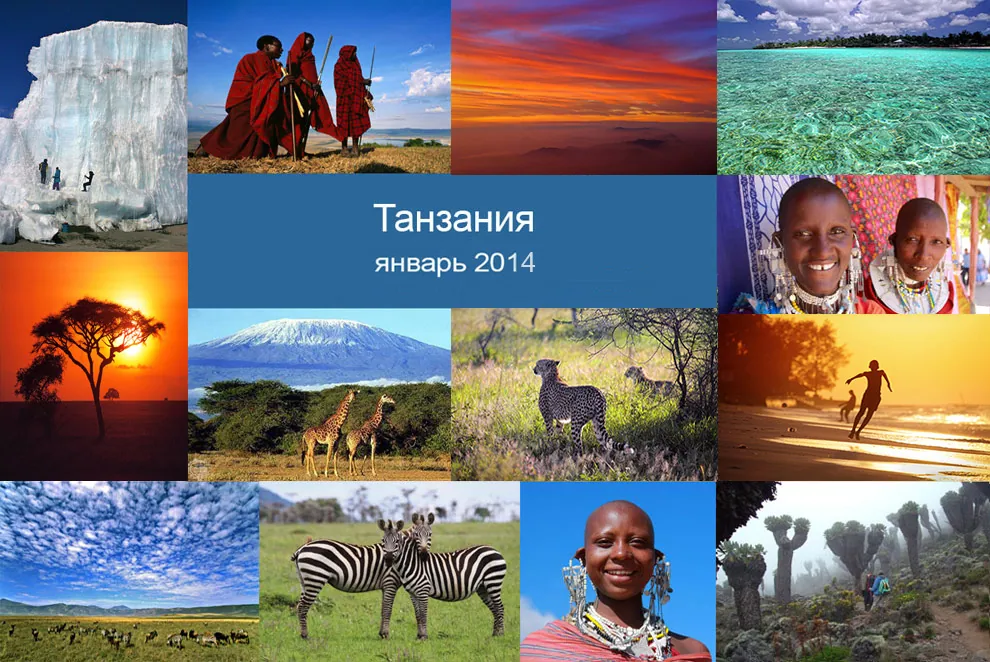
Friends, we are (for the third time now) setting off for Tanzania – the land of the Maasai, wild nature and turquoise beaches. As last year, we will once again climb Kilimanjaro, touch African snow and enjoy the beauty of the sunrise on the highest peak of Africa. We will once again plunge into the thrilling world of safari, feel the hunter’s excitement in the search for wild animals on the great plains of the Serengeti. Wild elephants, giraffes, lions, rhinos, leopards, hippos and cheetahs will be the heroes of our photographs. And more – the great migration of wildebeest, zebras and gazelles, one of the most epic, grandiose and breathtaking spectacles in the world of wild nature, which leaves no one indifferent. We will meet the Maasai tribe again and admire the views of the sacred volcano Ol Doinyo Lengai and of the huge soda lake Natron, pink with the millions of flamingos who live here. The last days, as before, we will spend on the famous island of Zanzibar. We will feel carried into a medieval Arab town as we stroll through the labyrinths of the narrow streets of Stone Town and the colourful eastern market, swim with dolphins and rest on beaches with white sand and the clearest turquoise water.
The programme of the trip:
- (6 January) Arrival at Kilimanjaro International Airport. Rest in the town of Arusha
2–5. (7–10 January) Safari in Serengeti National Park and the Ngorongoro Conservation Area, the great migration of zebras and wildebeest, lions and the whole “Big Five” of African animals.
-
Transfer to the Ngorongoro crater, in the afternoon a descent (600 m) into the crater. A first acquaintance with the whole variety of the animal world of Africa.
-
Transfer to the Serengeti. The expanses of the savannah and the great migration of animals.
-
An early rise and greeting the sunrise in the savannah, transfer to Lake Natron, the sacred lake of the Maasai tribe. Getting to know the tribe’s traditions.
-
An excursion to the lake and waterfalls, transfer to Arusha.
-
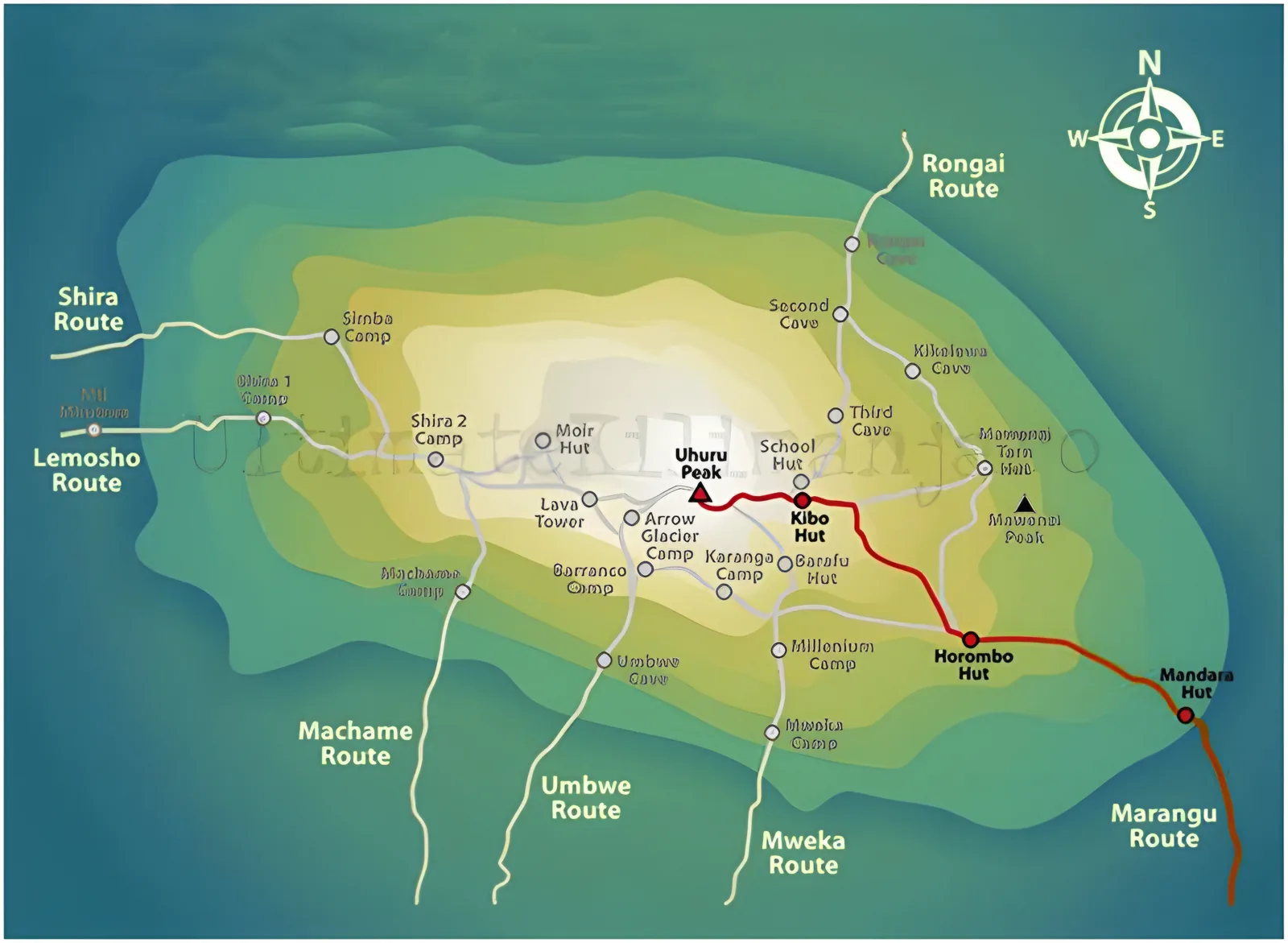
(11 January) Transfer to the foot of Kilimanjaro, the climb along the trail through the Mountain tropical rainforest to Mandara Hut (2700 m) (4 hours).
-
(12 January) The climb through alpine meadows and fields of low scrub to Horombo Hut (3700 m) (5 hours). From here there is a beautiful view of the peak of Mawenzi.
-
(13 January) The climb through fields of small scrub and barren stony slopes to Kibo Hut (4700 m) (6 hours).
-
(14 January) An early rise and the ascent (8 hours) across the stony desert and snow to the summit of Uhuru Peak (5895 m), descent to Horombo Hut.
-
(15 January) The descent to the Marangu Gate, transfer to Arusha.
-
(16 January) Flight to the island of Zanzibar.
-
(17 January) Walks around Stone Town (the Arab town) – narrow streets, the fish market, the former slave market, Freddie Mercury’s house, etc.
-
(18 January) Almost tame monkeys in the forest, swimming with dolphins and rest on beaches with turquoise water.
14–15 (19–20 January) Rest.
-
(21 January) Transfer to Tanzania’s former capital Dar es Salaam, a walk through the historic part of the city and Coco Beach.
-
(22 January) Flight home.
Budget: 3200 USD
This includes: transfers and journeys (including the Zanzibar–Dar es Salaam ferry), national park fees, a guide, porters on Kilimanjaro, accommodation, food during the Kilimanjaro climb and on safari, excursions and tickets to sights.
Not included: food on the other days (150–200 $), visa (50), international flights Moscow (Kyiv, Minsk) – Kilimanjaro and Dar es Salaam – Moscow (Kyiv, Minsk) (800–1200 $), the internal flight Kilimanjaro–Zanzibar, tips for porters, drivers, cooks etc. on the Kilimanjaro climb and on safari (150–200 $), personal expenses and insurance.
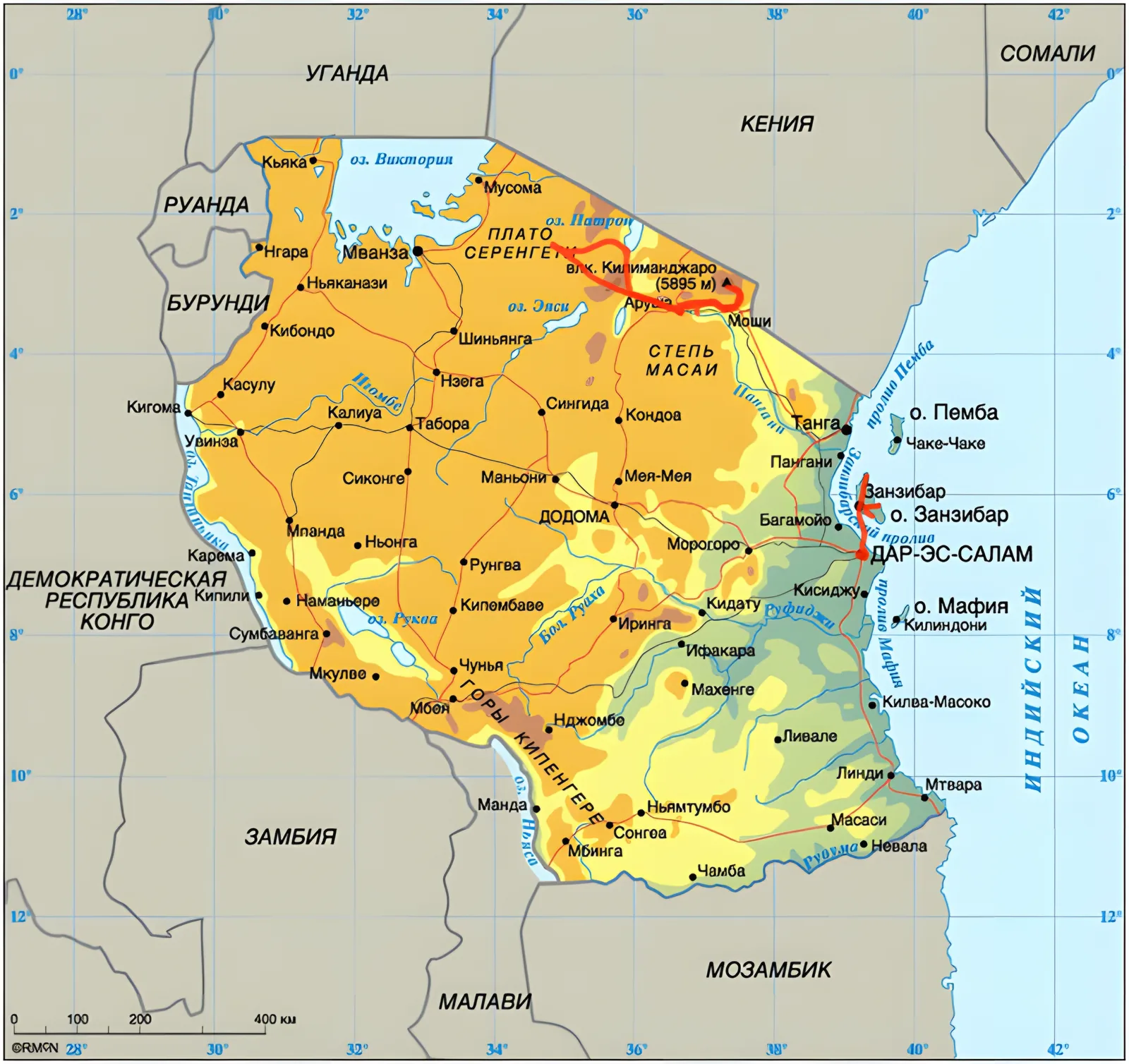
Route map:
Climate:
The climate in Tanzania is tropical, hot and humid on the coast but dry on the mainland. The rainy periods are in October–November (the “short rains” season) and in March–May (the “long rains” season). The dry season lasts 5–7 months. The best time to visit the north of the country is July–October and December–March, and the west (the coast) – December–March and May–October. On the islands of Zanzibar and Mafia it is best to rest in July–October and December–March. The average daytime temperature here is plus 28–30 degrees, and sea breezes make the weather very pleasant. The temperature of the water in the Indian Ocean is 24–26
Kilimanjaro is the highest peak of Africa (5895 m), and despite the hot climate below, eternal snows lie on the top of Kilimanjaro. The climb can be made all year round, but the clearest and warmest weather is from December–January to February – mid-March; at the end of March the rains begin. During the five days of the ascent to the summit several climatic zones succeed one another. On the lower slopes of the mountain bananas, coffee and maize are grown, up to a height of 3000 metres there is damp tropical forest, higher still, at about 4400 metres above sea level, the meadows give way to high-mountain lichens and mosses. Above that – only rock and ice. The temperature falls as you climb, and at the very summit it can drop to -5 (-15 in a strong wind). It is usually warm enough in the daytime, but after sunset it immediately turns sharply cold.
The climb of Kilimanjaro:
We plan to climb to the summit by the Marangu route, also known as the “Coca-Cola Route”, which approaches the summit from the south-east. Many prefer Marangu because it is considered the easiest on the mountain thanks to its gradual ascent and direct trail. Only on this route are there huts fitted out as shared dormitories (bunk beds at the stopping places. On the other ascent routes – only tents). Participants are also provided with mattresses and pillows (you need a sleeping bag). At the stopping places there are shared dining rooms, as well as minimal facilities: flush toilets and taps with water at the lower huts and wooden toilets and wells at Kibo Hut. After a successful climb everyone is given a certificate of having climbed the highest peak of Africa.
All questions to do with accommodation during the trip, food, transfers, buying air tickets, vaccinations and so on, you can find on the F.A.Q. page
Attention!!! To visit the island of Zanzibar in Tanzania an international certificate of vaccination against yellow fever is required. You can get such a vaccination and certificate at some city clinics in Kyiv, Moscow and Minsk and at private medical centres.
Photographs from past trips to Tanzania can be seen here: 2012. and 2013.
Contacts:
Mail: birukov2001@mail.ru
Skype: yury-birukov
Tel: (+38 096-33-77-199 – mobile.